3D Neon Voyager: A Cyberpunk Reimagining of Minesweeper
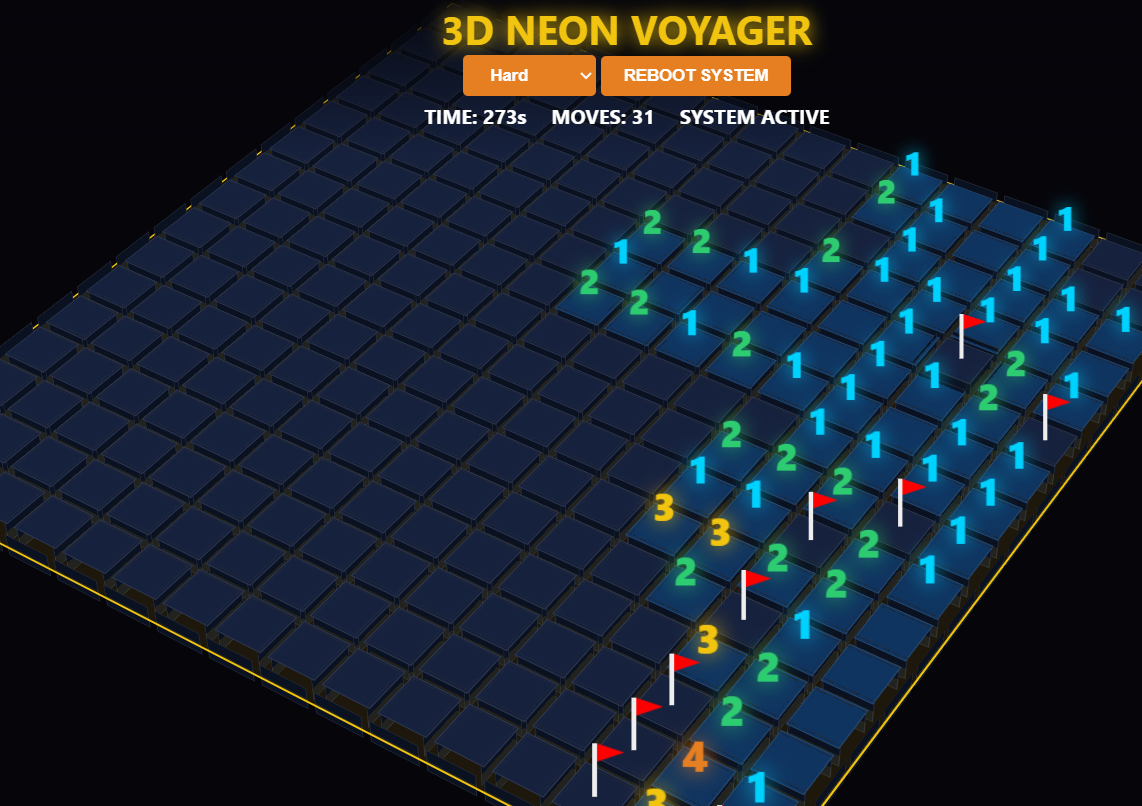
Step into the grid with 3D Neon Voyager. Experience the classic logic of Minesweeper built with advanced CSS 3D transforms, neon aesthetics, and a fully interactive, rotatable camera system.
Click here to access.
1. The Core Engine
The "engine" here is a custom-built State Management and Game Logic system written in Vanilla JavaScript. Unlike heavy game engines (like Unity or Three.js), this is a lightweight, event-driven engine.
- State Tracking: It manages a 2D array (
board) where each object stores properties likemine,revealed,flagged, andcount. - Game Loop: The engine uses
requestAnimationFrame(loop)to create a high-performance render loop. This ensures that camera movements (panning, zooming, and rotating) are updated at the display's native refresh rate (usually 60fps). - Recursive Logic: The
reveal(r, c)function utilizes a recursive flood-fill algorithm. When an empty cell is clicked, the engine automatically ripples through neighbors until it hits a numbered boundary.
2. Rendering Technology
The rendering is handled via CSS3 3D Transforms rather than WebGL or Canvas. This is an "orthographic-style" 3D approach that leverages the browser's hardware acceleration.
- Transform-Style: The use of
preserve-3don the viewport and board elements allows child elements to exist in a shared 3D space. - Z-Buffering Simulation: Each "cell" is a cube constructed of multiple
<div>faces. For example:- The
topface is moved forward usingtranslateZ(10px). - The
sidefaces are rotated (rotateXorrotateY) to create the illusion of depth.
- The
- Billboard Effect: A sophisticated technique is used in the
loop()function to keep numbers and flags facing the user regardless of how the board is rotated.- Mechanism: It applies a "counter-rotation" to the
.bb-containerthat exactly negates the camera's rotation.
- Mechanism: It applies a "counter-rotation" to the
3. Mathematical Tools
The project relies on 3D Coordinate Geometry and Input Mapping to translate 2D mouse movements into 3D transformations.
- Delta Calculation: The engine calculates the change (dx, dy) between the previous mouse position and the current one to adjust the Euler angles (
camX,camZ). - Linear Interpolation (Implicit): The camera uses scaling factors (0.3 for rotation, 0.8 for panning) to smooth out the movement, effectively acting as a simple sensitivity multiplier.
- Coordinate Mapping: To determine which cell was clicked in a 3D projected space, the code bypasses complex Raycasting by using standard DOM event bubbling (
e.stopPropagation()) combined with ID-based lookup (c-${r}-${c}).
4. Front-End Environment
The environment is a Modern Web Stack designed for high-fidelity "Neo-Retro" aesthetics.
- CSS Variables (Custom Properties): The theme is managed via
:rootvariables (e.g.,--neon-blue,--grid-glow), making the UI "skinnable" and maintaining consistent glow effects throughout the app. - Responsive Viewport: Uses a
flex-direction: columnlayout where the UI panel is fixed, and the 3D viewport expands to fill the remaining space. - Dynamic DOM Injection: The board is not hard-coded; the JavaScript dynamically generates the HTML grid and assigns 3D face elements based on the selected difficulty (Easy, Medium, Hard).
- Event Listeners: It utilizes
contextmenuoverrides to allow the right-click to function as a "flag" placement without opening the browser's default menu.