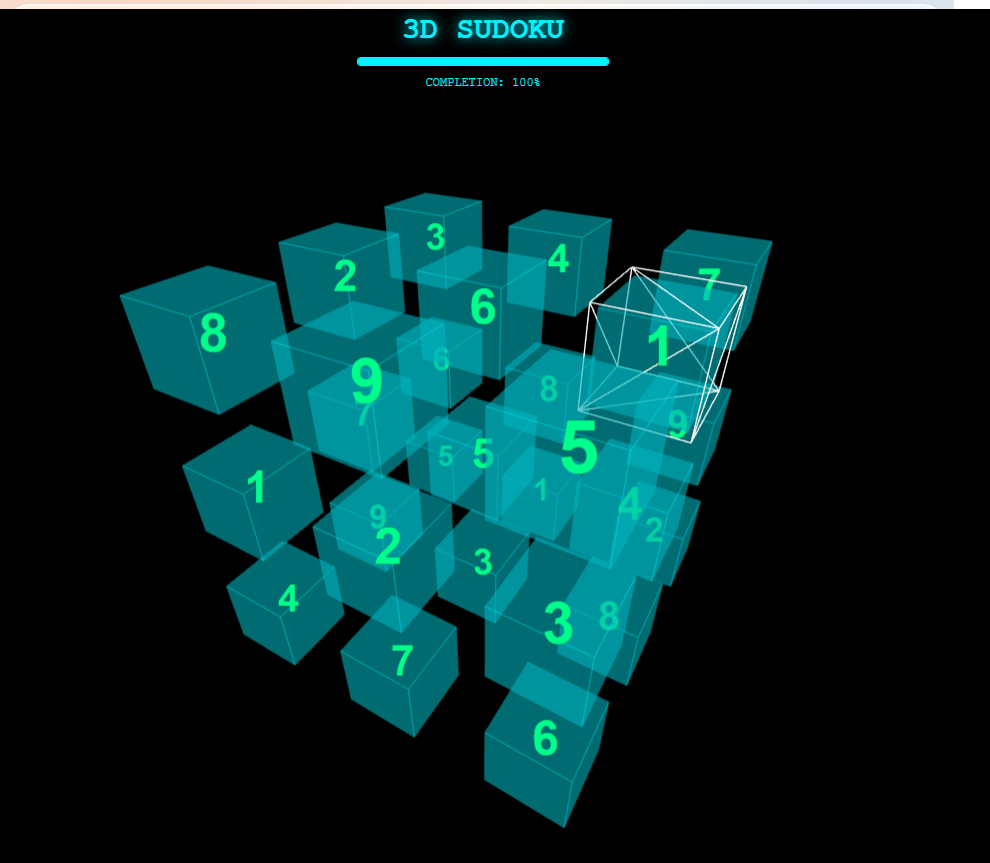
A spatial-awareness puzzle in the shape of a Sudoku, where every cell sits at the intersection of three constraint dimensions instead of two.
I keep coming back to spatial awareness. It's the most undertaught skill in engineering education and the one students struggle with longest. Reading projection drawings, routing pipes through a 3D volume, rotating tetracubes in a falling-block game — these all develop the same underlying muscle: the ability to hold a 3D structure in your head and reason about it from multiple angles at once.
3D Sudoku is another piece of that training, applied to a different mental movement: not visualising a shape, not routing a path, but checking constraints across overlapping dimensions.
Play it here — runs in any modern browser. Two grid sizes (3³ or 4³ cube), three overlapping constraint axes.
Who this is for
The audience is anyone training their spatial awareness. Engineering students whose curriculum doesn't quite get there. Anyone who has solved enough 2D Sudoku to want a fresh challenge. Anyone who likes thinking in three dimensions, or who has wondered what a "3D Sudoku" might actually feel like to play. This is part of the same spatial-reasoning series as Umbra, Lattice, and Tetris 3D — the mechanic is different, but the brain-training is similar.
How the game works
You see a translucent 3D cube, divided into either 27 cells (3×3×3) or 64 cells (4×4×4). Some cells are pre-filled with digits. Your job is to fill the rest, satisfying three rules:
- Every horizontal row across the cube contains each digit exactly once
- Every vertical column down the cube contains each digit exactly once
- Every depth-running pillar through the cube contains each digit exactly once
(For the 4×4×4 version, sub-grid constraints also apply on the 2×2 slices, mirroring the box constraint of classical Sudoku.)
Click any cell to select it. Type a digit. The cube rotates as you orbit it, so you can inspect any face. Conflicts pulse red. The whole cube glows softly in neon when you reach a solution.
The core idea
The principle is that classical Sudoku trains a specific mental skill: tracking multiple overlapping constraints simultaneously. The 9×9 grid asks the solver to consider, for every cell, which digits are allowed in its row, in its column, and in its 3×3 box — three constraint systems applied to the same cell. That triple-bookkeeping is the puzzle's core challenge.
3D Sudoku extends that core challenge into the third dimension. Every cell now sits at the intersection of three lines — row, column, and pillar — instead of two. The solver has to check three constraint systems for every move, then reconcile them against each other in 3D space. The 4×4×4 version adds box constraints on top, which makes the dimensional bookkeeping even more demanding.
The result is a puzzle that pushes the same skill Sudoku develops, but in a higher-dimensional setting. It's not "Sudoku with more cells." It's a spatial-reasoning workout that uses Sudoku as its scaffold. The pedagogical effect on students who play it regularly is the same as Umbra's and Lattice's: a sharpening of the 3D thinking muscle that most curricula leave untrained.
The moment three constraints become one
The reason for building this is a moment that happens once you've solved your first puzzle. Early on, you forget the depth constraint. You correctly fill rows and columns and the cube refuses to accept the answer. You squint at it, rotate it, find the duplicate digit in a pillar you weren't paying attention to. Then it clicks. You start seeing the cube as three overlapping constraint systems rather than one.
That moment is the same one Umbra produces with shadows and Lattice produces with paths. The shape is different, but the muscle is the same — the brain training itself to consider three dimensions at once instead of two.
What this is
A spatial-awareness puzzle in the shape of a classical Sudoku. Same family as Umbra, Lattice, and Tetris 3D — different mechanic, similar training. Classical Sudoku lifted into three dimensions, with the same elegant ruleset and the same satisfying solving experience. Free, no account, runs in any browser.
Coming next
A tutorial article and YouTube video are in production: how this puzzle was built with AI coding agents, including the 3D backtracking algorithm and the constraint validation. Subscribe for when it ships.