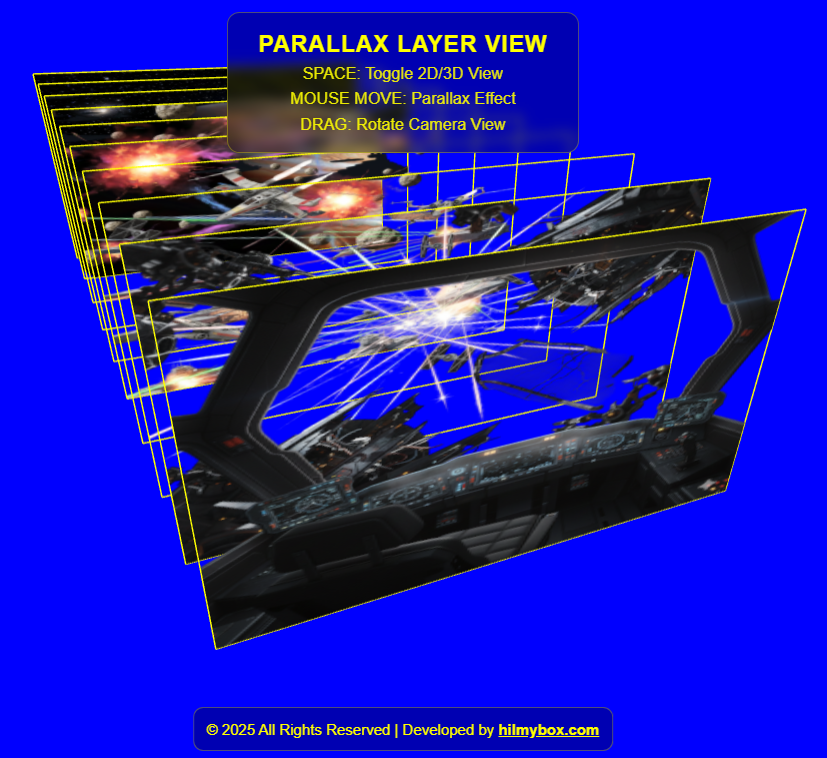
A modern web take on the multiplane camera technique used in Disney's classic animated films — for the moment two-dimensional layers stop feeling flat.
Walt Disney Studios invented the multiplane camera in the 1930s. The idea is simple. Instead of filming a single flat painting, you separate the scene into multiple layers — background, midground, foreground — and physically space them apart. When the camera moves, each layer moves at a different rate, producing parallax. The flat painting suddenly feels three-dimensional.
The multiplane is one of the loveliest analog techniques in the history of animation. Lifting it into the browser turned out to be a small, satisfying project.
You can try it here.
What it is
A browser-based multiplane camera effect. Ten distinct layers float in 3D space. Mouse movement triggers parallax — each layer shifts at a rate proportional to its depth, producing the same dimensional feel Disney achieved with their physical machines. A toggle smoothly transitions the scene between "stacked" (all layers flat, the original 2D view) and "exploded" (layers spaced apart in 3D), so you can see exactly how the trick works.
The aesthetic is "production suite" — high-contrast blue with yellow technical outlines. Closer to a film-studio camera rig than a finished animation.
What stayed with me
The realisation that animation history is full of techniques worth porting. The multiplane is from 1937. The principle generalises directly to anything browser-based that wants depth from flat assets. Once you know the technique, you can see it being approximated badly in countless modern websites that use CSS parallax without understanding what they're imitating.
The wider observation was that respecting the lineage of a technique makes the project richer. Calling this a "parallax scroller" would have been technically accurate but historically lazy. Calling it a "multiplane engine" connects it to a hundred years of craft, which is a more interesting frame to build under.
Part of the early experiments — porting old animation techniques into the modern browser.