Chromatic Corridors: Crafting a Spectacular 3D Maze
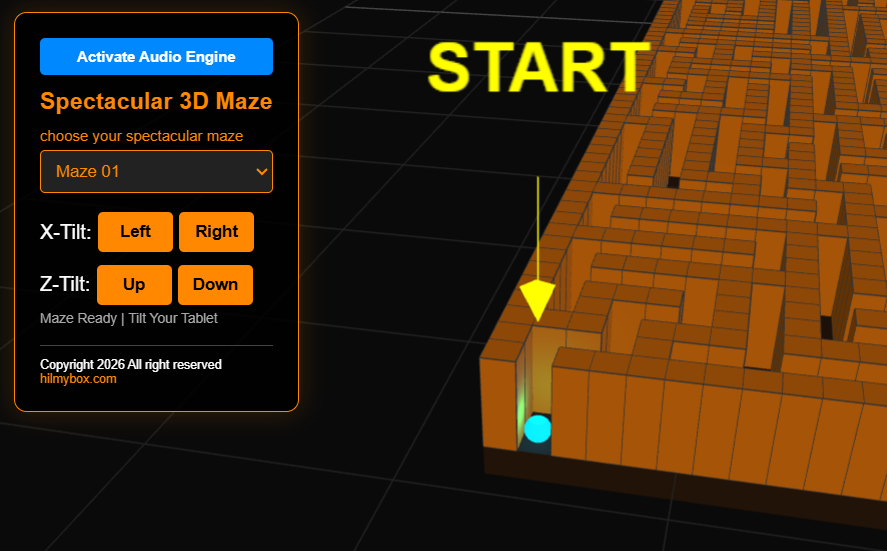
Step into a world where geometry meets gravity. Spectacular 3D Maze is not just a digital puzzle; it is a high-performance web experience built on the cutting edge of WebGL and Three.js. Designed for both the precision of a desktop keyboard and the tactile immersion of tablet tilting, this project transforms flat PNG images into towering, orange-hued architectural masterpieces.
Wrapped in a sleek, "Cyber-Orange" aesthetic, the experience is grounded by a custom coordinate system and a soothing, procedurally generated audio engine. Whether you are navigating the default maze or exploring internal expansions, every movement is calculated with real-time collision detection to ensure a challenge that is as smooth as it is spectacular. Securely hosted and built with a commitment to integrity, it’s time to tilt your perspective and find your way through the spectacular.
Click here to access.
1. The Core Engine: Logic & Mechanics
The "brain" of your application is a custom-built simulation engine that manages game state and physical interactions.
- Grid-Based Spatial Mapping: The engine uses an internal 2-dimensional array (
mazeData) derived from image pixel data. This acts as a high-speed lookup table for collision detection. - Collision Response System: Unlike simple "stop" logic, the engine uses independent axis validation. This allows the player to "slide" along a wall if they are moving diagonally, providing a much smoother user experience.
- Device Orientation Integration: It maps raw sensor data (Beta and Gamma angles) from a tablet’s accelerometer into a normalized force vector, simulating real-world physics and gravity.
2. Rendering Technology: Graphics & Audio
The visual and auditory experience is powered by professional-grade web APIs that handle real-time synthesis.
- Three.js WebGL Renderer: The code utilizes the
WebGLRendererwith InstancedMesh. This is a spectacular optimization technique that allows the GPU to render thousands of walls as a single draw call, ensuring 60 FPS even on mobile devices. - Procedural Audio Synthesis: Instead of loading heavy MP3 files, the project uses the Web Audio API. It synthesizes a "soothing hum" using a Sine-wave oscillator and a Low-Pass Filter (LPF) to create an ambient, zen-like atmosphere.
- Dynamic Lighting: A combination of
AmbientLightfor base visibility and aDirectionalLight(Sun) provides the shadows and depth that make the orange walls look 3D.
3. Mathematical Tools: The Geometry of the Maze
Behind every spectacular view is a set of precise mathematical formulas.
- Coordinate Normalization: The code translates "Pixel Space" (0 to 101) into "3D World Space" (-50.5 to 50.5) using the formula x - TARGET_SIZE/2. This ensures the maze is always perfectly centered at the origin (0, 0, 0).
- Vector Linear Interpolation (Lerp): The camera doesn't snap to the ball; it "follows" it smoothly using
.lerp(). This calculates a point between the current camera target and the player's position to create a "dampened" trailing effect. - Buffer Geometry Merging: To generate the clean outlines of the maze, the code uses
BufferGeometryUtilsto merge separate boxes into a single complex geometry, allowing for efficient edge detection.
4. Front-End Environment: Interface & Security
The environment provides the bridge between the user and the code while protecting your intellectual property.
- Asynchronous Image Loading: The system uses the
Image().onloadpattern, ensuring the 3D world only generates once the maze texture is fully loaded into memory. - Import Maps: Modern ES6 Module management is used via
<script type="importmap">, allowing the code to stay clean and modular without needing a complex build system like Webpack. - Integrity Guard (Security): A "Multi-Protection" loop runs a background check every 3 seconds. It verifies the existence and visibility of the
backlinkandcopyright-areain the DOM; if they are tampered with, theisProtectedflag stops the engine immediately.