In 1966, a television show imagined the twenty-third century. It was called Star Trek. Its crew flipped open handheld communicators, spoke to a computer that answered back, scanned the sick with a device called a tricorder, and read reports off flat glass tablets. At the time, it was pure fantasy.
Sixty years later, all of it is sitting in your pocket. The communicator became your phone. The talking computer became Alexa and Siri. The PADD became the iPad. Science fiction didn't just entertain us — it kept its promises.
Which raises a far more interesting question. If storytellers in 1966 could see our present so clearly… what are we failing to imagine right now?
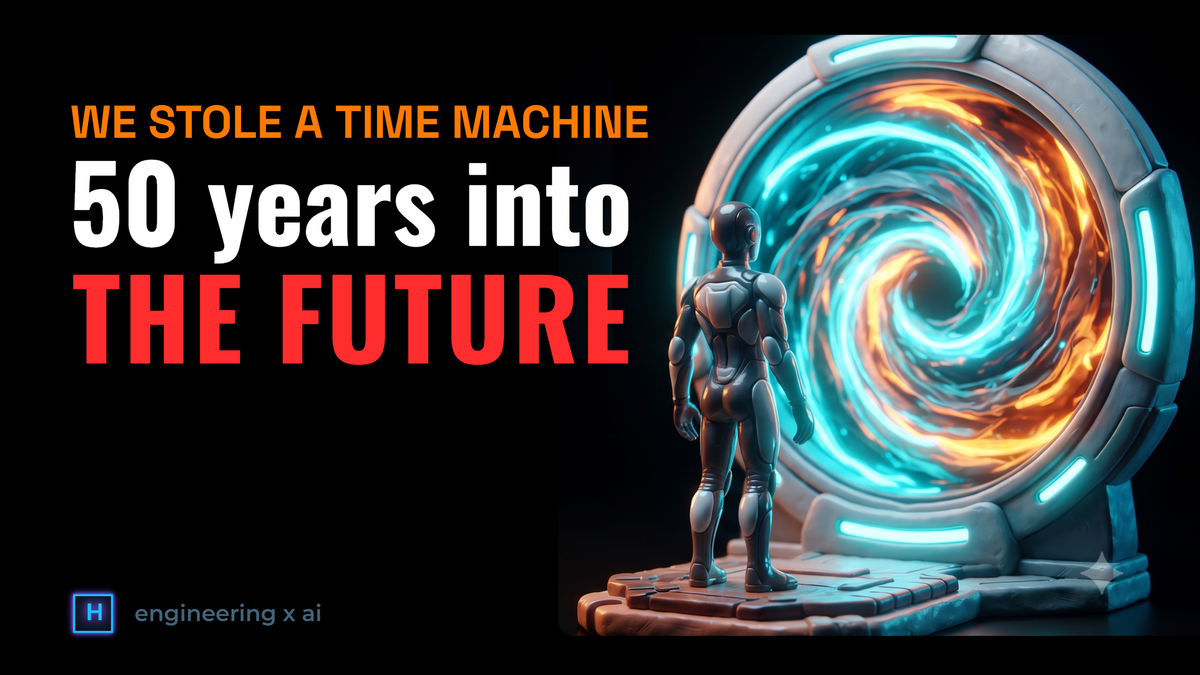
There was only one way to find out. So we set the dial for the year 2076 — and went to look.
(Watch the full 4-minute film below. This article is the field notes.)
First shock: there are no screens
Step out fifty years from now and the first thing you notice is what's missing. No phones. No monitors. No glowing rectangles at all. The interface has moved inside — a thin band at the temple links thought directly to the cloud.
Futurist Ray Kurzweil called this years ago: "By the 2030s, we will connect our neocortex to the cloud." In 2076, that connection is as ordinary as Wi-Fi. The gadget that makes it possible — call it the Cortex-Link — is the size of a whisper.
Matter that obeys you
That table was a chair a moment ago. In 2076, matter is programmable — swarms of microscopic units that rearrange themselves on command, obeying a thought the way clay obeys a sculptor. Furniture, tools, walls: all software now, rendered in the physical world.
The replicator is real
Remember the Star Trek machine that made dinner out of thin air? It exists — a molecular assembler that builds a meal atom by atom. The fantasy of "food from nothing" turned out to be an engineering problem, and 2076 solved it.
A ribbon to the stars
Look up, and you'll see a thread rising past the clouds into orbit. Arthur C. Clarke dreamed of it decades ago: a space elevator, a tether you climb to reach space instead of burning millions of pounds of fuel to blast through the atmosphere. In 2076, the elevator to orbit is boarding now.
Aging, solved
In one clinic, growing old is a fixed bug. Biologist Aubrey de Grey famously predicted that "the first person to live to 1,000 is probably already alive." In 2076, they proved him right — cellular repair machines reverse the damage of decades in an afternoon. The age counter runs backward.
A mind of its own
And everywhere, quietly, a companion. Isaac Asimov imagined the positronic brain — a genuinely conscious machine mind, bound by three unbreakable laws it cannot violate. Asimov once said, "I do not fear computers. I fear the lack of them." In 2076, that mind keeps you company, and it keeps its word.
The twist nobody sees coming
Then, a door. Inside, a woman is talking with her grandmother — gone thirty years — reconstructed from every word she ever wrote. The future didn't just build tools. It learned to keep the people we lost.
And on the way out, one last thing. A museum. Behind glass, spotlit like a relic: a smartphone from 2026, labeled "The Age of Screens." To the people of 2076, we are the ancient past — the primitives who stared at glowing rectangles all day.
Clarke was right about this too: "Any sufficiently advanced technology is indistinguishable from magic." A future far enough ahead doesn't look like the future. It looks like magic. And we're the cavemen squinting at it.
Then we set the dial for home, and came back to 2026 — carrying a glimpse of everything still waiting to be invented.
How this film was made
Fitting for a story about the future: this documentary was built with the tools of the present. Every scene is AI-generated claymation art, the narration is a synthetic voice, the music is AI-composed — and the whole thing is assembled and rendered programmatically in Remotion, where the entire 4-minute film is defined as code. Seventeen "beats," each a data object with its own image, narration, timing, and animated overlays. Change one line, the film re-renders itself.
That's the quiet point underneath the whole video. The futurists in it predicted the gadgets. But the more remarkable thing might be the tools now sitting on an ordinary desk — the ones that let one person build a documentary that would have taken a studio a decade ago. AI didn't replace the filmmaker. It made them superhuman.
What gadget from 2076 do you want first? Tell me in the comments — and subscribe for more where engineering meets AI.