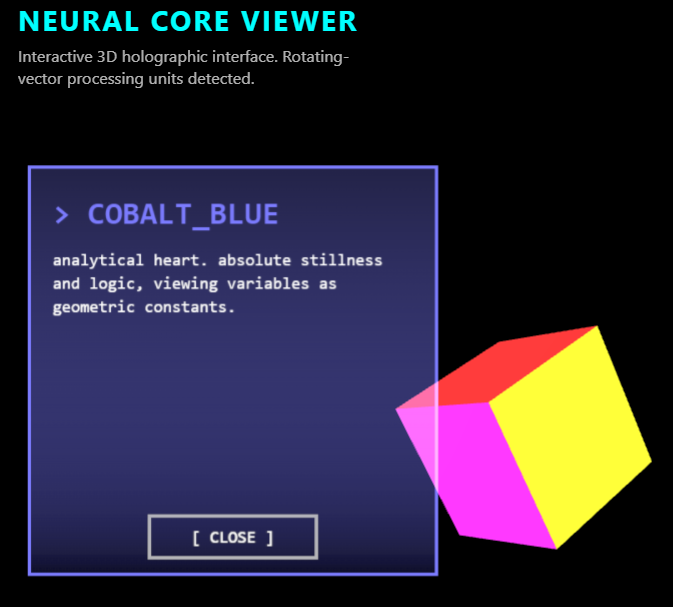
A small portfolio piece — a rotating cube where each face decodes a different aspect of the work, with text typing itself onto the surface.
This was a portfolio experiment. The question was: could a portfolio site itself be an interactive 3D object, where each face of a rotating cube represented a different category of work, with the descriptions typing themselves onto the surface as the cube rotated to face the camera?
The answer was yes, and the result was charming enough to keep around as part of the journey, even though I never quite found the right home for it. Click here to access.
What it is
A rotating cube floating in 3D space. Click a face, and the cube rotates to bring that face forward while a typewriter effect decodes a description of the work onto the face itself. The text isn't a fixed label — it's rendered onto a dynamic 2D canvas which is then uploaded to the GPU as a texture, refreshing every few frames as the typewriter advances.
The aesthetic is "holographic data terminal" — emissive materials, glow effects, a futuristic feel.
What stayed with me
The discovery that dynamic textures are surprisingly powerful. By rendering text to a 2D canvas and uploading the canvas to the GPU as a texture every frame, you get arbitrarily-complex 2D content on 3D surfaces — fonts, animations, anything that can be drawn on a canvas. That technique is the basis for the on-surface labels in many later projects.
The portfolio framing also made me realise that the journey itself is a piece of work worth presenting. Rather than treating my projects as a flat gallery, a structured presentation that decodes them one at a time has a narrative quality the gallery doesn't. The site you're reading is partly an evolution of this thought.
Part of the early experiments — building the small techniques that fed the bigger ones.