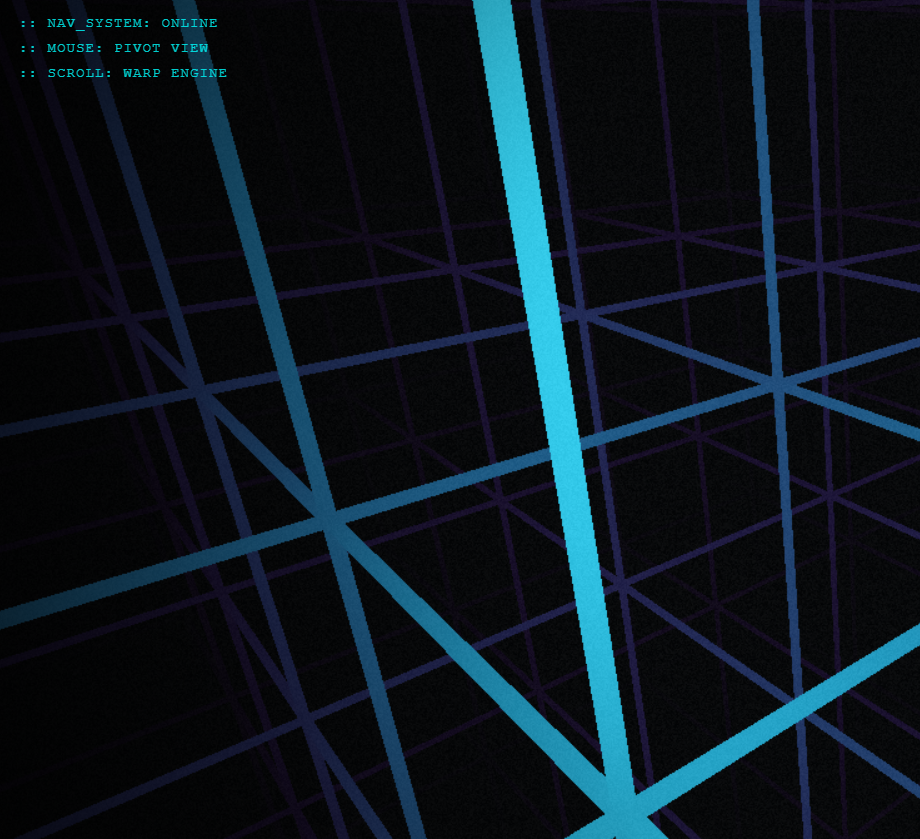
A raymarched infinite architectural abyss — built to see how much could be drawn from nothing but math.
There's a corner of computer graphics that doesn't use 3D models at all. Instead of polygons, geometry is described by mathematical functions — signed distance fields that, for any point in space, return how far that point is from the nearest surface. The renderer then "raymarches" through space, stepping forward until it hits something.
The trade-off is interesting. Polygon-based 3D scales linearly with detail: more detail, more polygons, more memory. Raymarching scales differently — the geometry is the equation, not the data. You can describe infinite spaces with no extra memory cost. The only limit is the GPU's willingness to keep marching rays.
Tesseract is an experiment in that corner. Click here to access.
What it is
An infinite architectural abyss — a procedurally repeating lattice of beams that stretches in every direction. The space appears to extend forever because the geometry is calculated on the fly from a modular arithmetic operation that folds 3D space onto itself.
You move through the space by scrolling and dragging the mouse. The space reacts in real time. Nothing is loaded; nothing is streamed; the entire visual is computed by the GPU from a small fragment shader, frame by frame.
What stayed with me
The realisation that raymarching is a completely different graphics paradigm from the polygon work most browser projects do. For certain kinds of content — infinite procedural spaces, fluid forms, organic surfaces — it's a better fit than polygon meshes. Most of my projects don't need it. But knowing the technique exists, and knowing roughly when to reach for it, expanded the toolbox.
The other lesson was about WebGL fragment shaders as a creative medium. The entire visual lives in about 200 lines of GLSL code. That's small enough to be a sculpture, large enough to express genuine complexity. Several visual effects in later projects came from techniques first explored here.
Part of the early experiments — venturing into the procedural graphics corner of the rendering world.