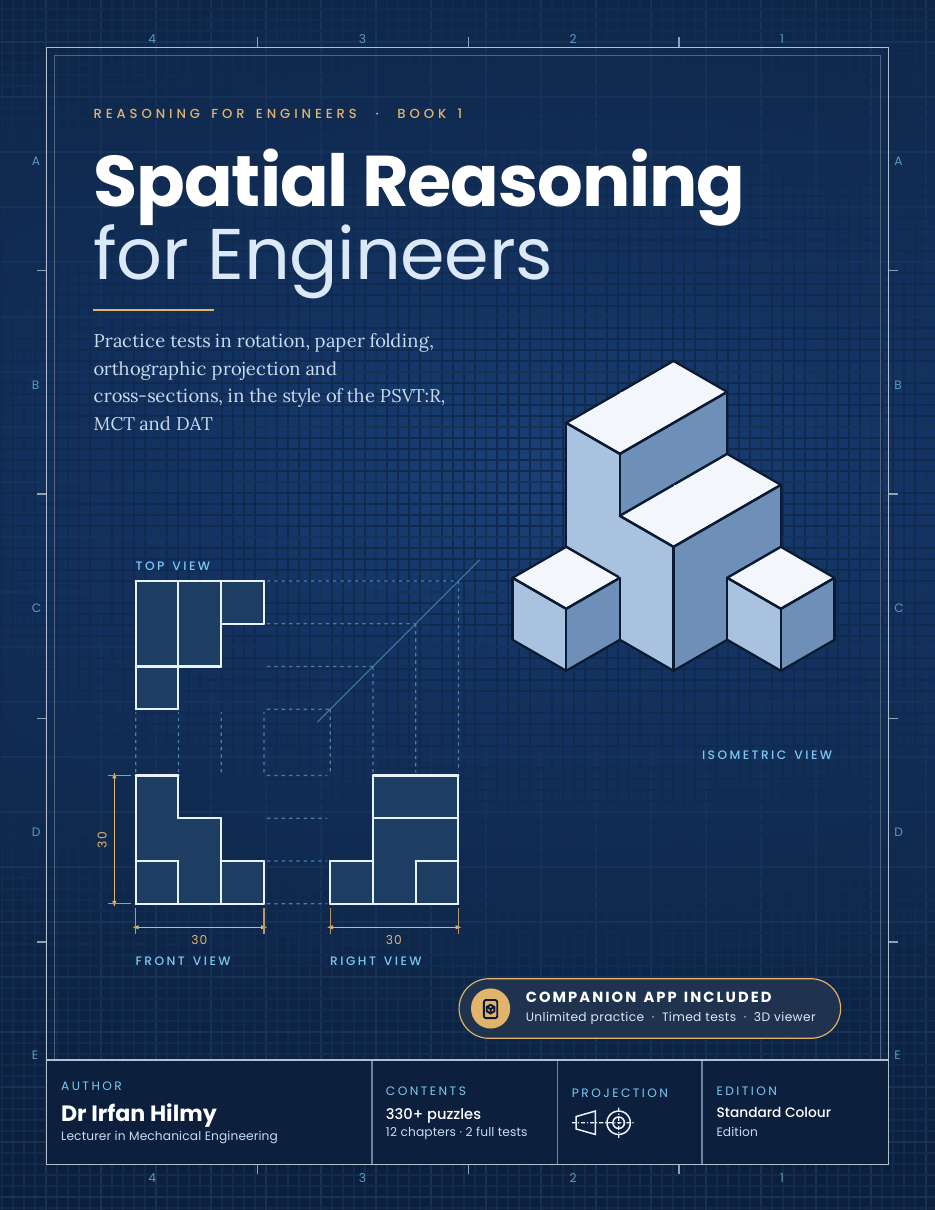
By Dr Irfan Hilmy · Reasoning for Engineers series, Book 1 · Now available on Amazon
Look at a drawing of a bracket. Can you see what it looks like from the side? Can you fold a flat net into a cube in your mind, or tell which shape appears when a solid is cut? These are spatial skills, and engineers use them every day.
In nearly 30 years of teaching engineering, I have watched many capable students struggle, not with the mathematics, but with seeing the object. They can calculate a stress, yet a set of orthographic views or a 3D rotation leaves them stuck. The good news, and it is well supported by education research, is that spatial skill is not fixed. It improves with the right kind of practice, often quickly.
That is why I wrote Spatial Reasoning for Engineers, the first book in my new Reasoning for Engineers series. The paperback is now available on Amazon. Before you buy, you can try three chapters of its companion app for free (see below).
What is in the book
- 12 chapters and more than 330 original puzzles, from 2D rotation and paper folding to cube nets, orthographic views, counting blocks, 3D rotation, cross-sections and apertures.
- Two parallel 60-question practice tests, so you can test yourself before the chapters and again after them, and see exactly which skills improved.
- A clear plan in every chapter, based on the 5E teaching model: try a question first, learn the strategy, study two worked examples, practise with 12 graded questions, apply it to a real engineering task, then take a short chapter test.
- Fully explained answers for every question, not just a letter.
- The Cubist Challenge: 57 questions built from the levels of my free Cubist game here on Hilmybox.
Every puzzle was generated by computer, and every answer was checked by a separate computer solution to make sure exactly one option is correct. Wrong or ambiguous answers are the most common complaint about practice books, and I wanted readers to be able to trust every key.
A companion app comes with every copy
Practice works best when you get immediate feedback, so every copy of the book includes a free web app that runs on a phone, tablet or computer.
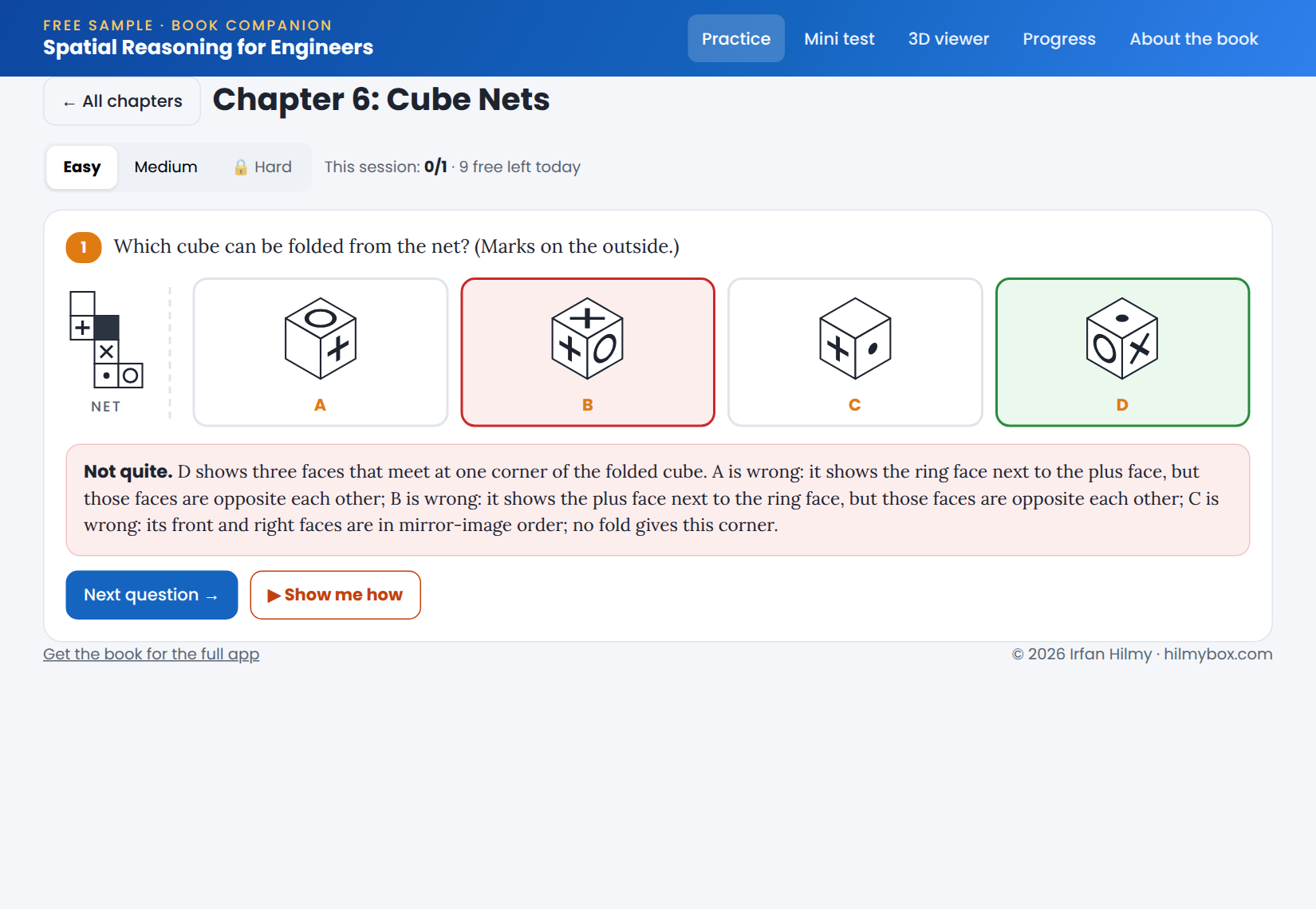
- Unlimited practice for all 12 chapters at three levels, with every question checked by the computer.
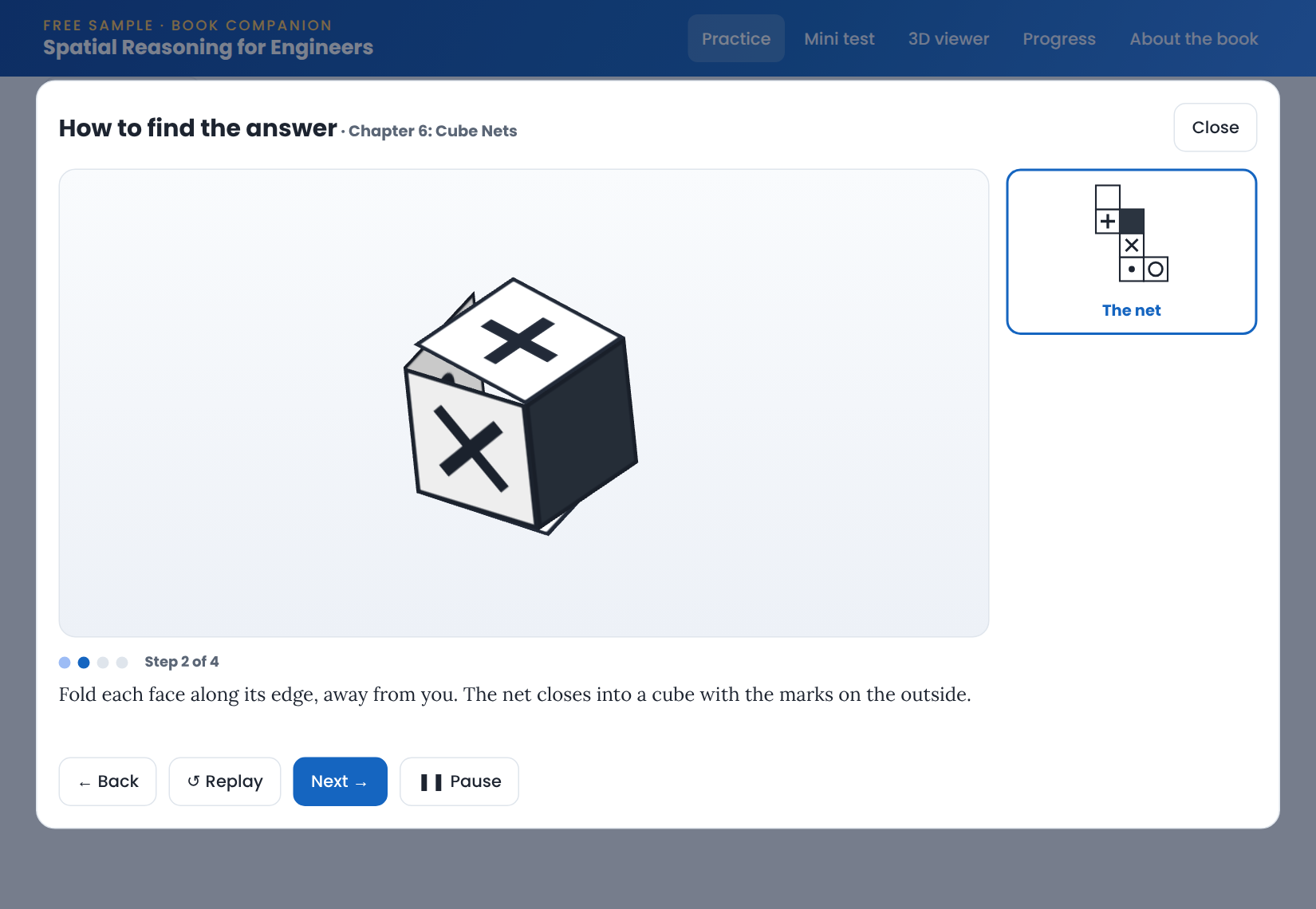
- Show me how: watch the answer being worked out. The shape turns, the paper unfolds, the net folds into a cube, the solid is cut open.
- Timed tests in the same format as the book, with a score for each section and advice on what to study next.
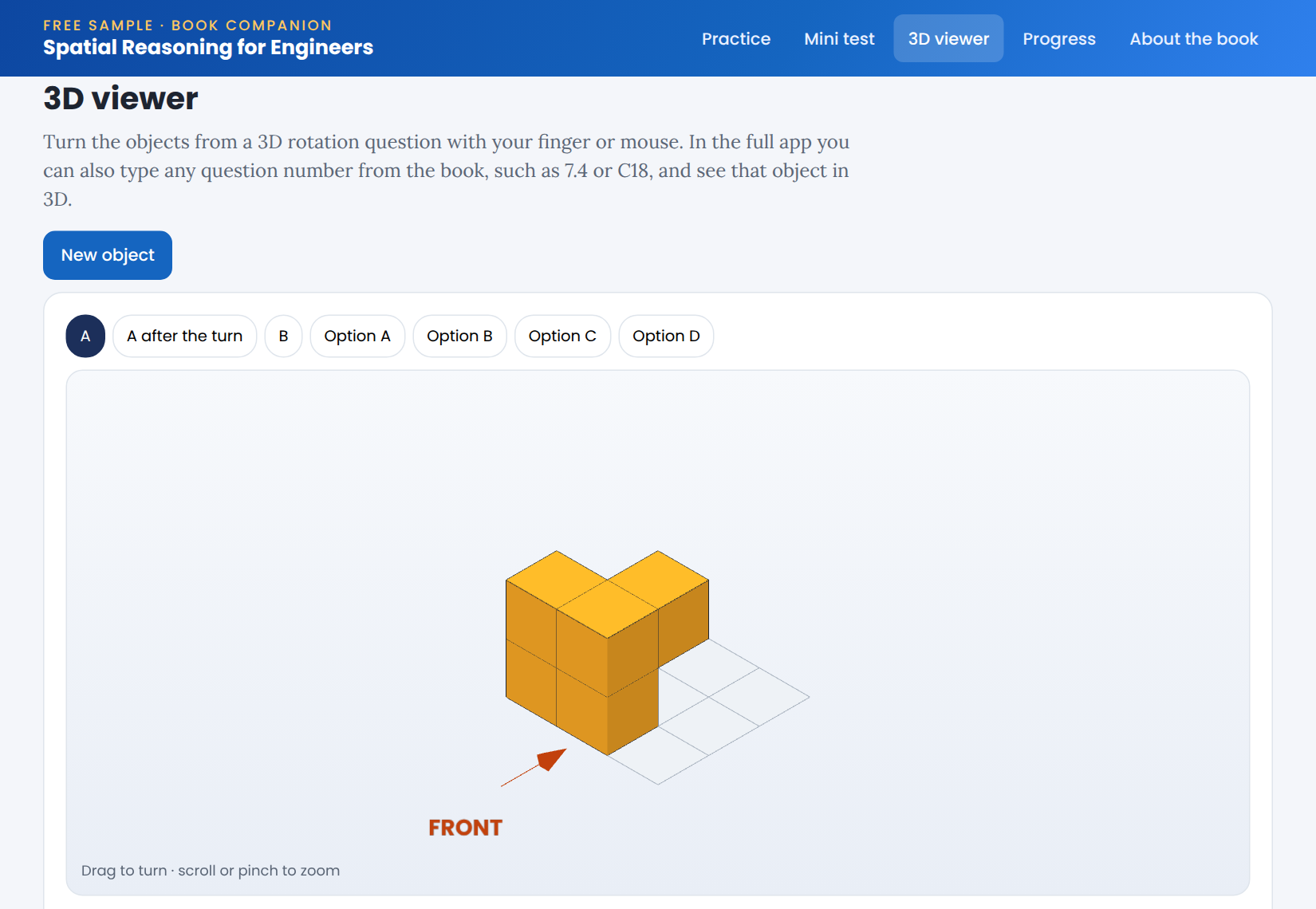
- A 3D viewer: type a question number from the book and turn the object with your finger to check your answer.
Try it free: read Chapter 1
Download a free 17-page sample of the book: the contents, how to use the book, the whole of Chapter 1: Rotation and Mirror Images with its practice set and answers, and the first questions of Practice Test A. Print it, try the questions with a pencil, and see if the approach works for you. You are welcome to share the PDF with friends and students.
Try the app: three chapters, no sign-up
I have also made a free sample of the companion app so you can try it before you buy. It opens three chapters, one from each part of the book: Rotation and Mirror Images, Cube Nets and 3D Mental Rotation. You get 10 free questions per chapter each day, a short timed mini test, the step-by-step walkthroughs and the 3D viewer.
Who it is for
- Engineering and design students who find drawing, CAD or 3D visualisation hard, especially in the first year.
- Candidates preparing for aptitude tests with a spatial or mechanical section, for university places, apprenticeships, technical jobs or the armed forces.
- Instructors who want ready-made, structured practice: each chapter fits a 50 to 60 minute class, and Tests A and B work as a pre-test and post-test.
How to use it
The plan is simple: test, train, retest. Take Practice Test A first, without studying. Your section scores show your weakest skills. Work through those chapters first, using the app for extra practice. Then take Test B and compare, section by section. The sections where you start lowest usually have the most room to grow.
What comes next
Spatial Reasoning for Engineers is Book 1 of the Reasoning for Engineers series. Book 2, Mechanical Reasoning for Engineers, covers levers, pulleys, gears, forces and fluids, and more titles are on the way. Each book has the same structure and its own companion app.
The paperback is available now on Amazon, and every copy includes the full companion app. I would also love to hear how you get on with the free sample: email me at [email protected].
Happy practising! Dr Irfan Hilmy