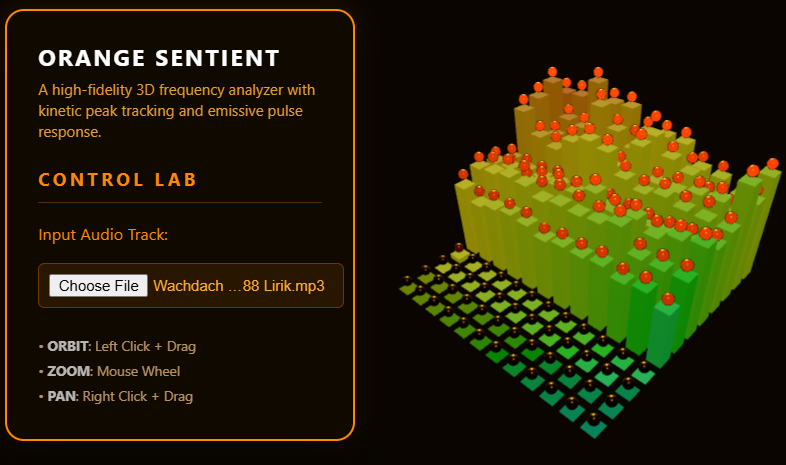
A small experiment in turning music into kinetic 3D art — built for the satisfaction of watching sound become shape.
Audio visualisation is one of the older genres of generative graphics. Winamp had Milkdrop in 1998. Modern tools have far more compute available, but the core challenge is the same: take a continuous audio signal, decompose it into frequency components in real time, and turn those components into visible motion that feels connected to what the listener is hearing.
Orange Lab is a small experiment in that genre, built for the browser. Click it here.
What it is
A 3D scene where audio drives motion. A grid of small spheres floats in front of you, each one tied to a different frequency band of whatever audio you feed in. Loud bass pushes the bass-band spheres upward; high treble pushes the treble-band spheres. Each sphere has its own simple physics — pushed up by audio energy, pulled down by gravity — so the response feels organic rather than purely reactive.
What stayed with me
The technical lesson was about the Web Audio API. Browser audio used to be limited to playing files. By 2025 it had become a full real-time audio processing pipeline — FFT analysis, dynamic synthesis, audio worklets — capable of building things that would have required a dedicated DAW a decade earlier.
The design lesson was that adding lightweight physics to a reactive system makes it feel alive. A pure linear mapping from audio amplitude to visual height looks robotic. The same mapping with a touch of inertia — the sphere accelerating upward, gravity pulling it down — looks like something that's listening. That trick recurs in several of the later projects whenever something needed to feel less mechanical.
Part of the early experiments — exploring what the browser's audio pipeline could carry.