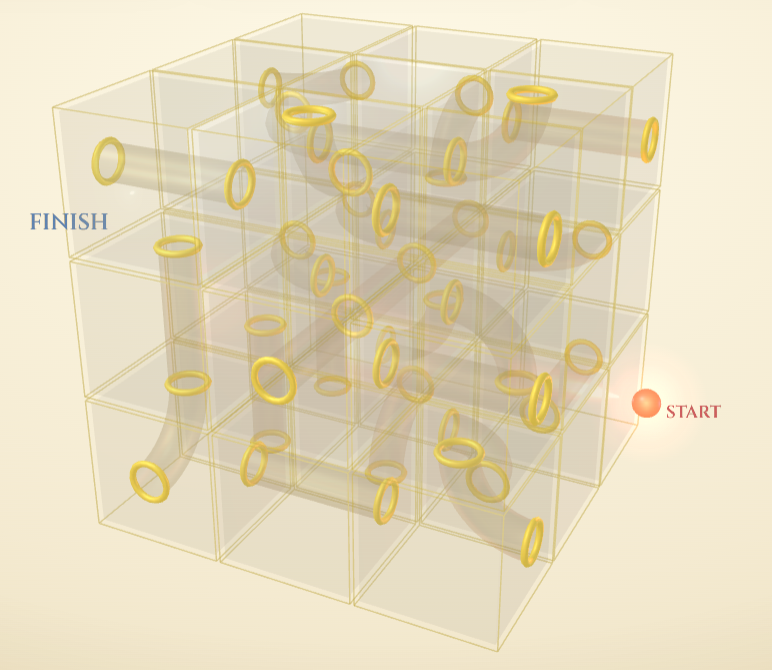
A second spatial-reasoning puzzle from the drawing-class series — this time about finding a path through a 3D grid.
I built Umbra to teach the inverse projection problem — going from 2D shadows back to a 3D object. Lattice is the second game in the same series, but for a different kind of spatial weakness: visualizing a path through three-dimensional space.
Engineering students who can read projection drawings sometimes still struggle when the question shifts from "what shape is this?" to "how do I get from A to B through this maze of cells?" That's a different mental muscle. Architects know it. Plumbing and electrical designers live with it. CAD students hit it the first time they try to route cables through a board layout. The skill is path visualization — holding a 3D route in your head and predicting whether it will work before you commit to it.
Lattice is a puzzle game built around that exact problem.
Play Lattice here — runs in any modern browser. Three difficulties (27, 125, or 343 cubes), one HTML file you can email.
Who this is for
The audience is anyone who needs to think about routing in three dimensions. Plumbing and pipe designers. Cable and harness designers. Architects laying out conduit. Engineering students learning to read isometric drawings. Or anyone who likes 3D puzzles for their own sake and wants something more thoughtful than a maze game.
How the game works
A glowing red-hot ball sits at the START marker on one face of a large cube. Your job is to get it to the FINISH marker on a perpendicular face. Between them sits a lattice of smaller cubes — 27, 125, or 343 of them, depending on difficulty. Each small cube contains one pipe segment, either a straight piece or a 90° elbow, in a random orientation.
You can rotate any cube around its three axes, or swap between straight and elbow shapes. Your goal is to connect every cube end-to-end into one continuous channel from START to FINISH. The win condition is strict: the path must pass through every single cube. No shortcuts. No leftover cubes. When you solve it, the ball glides through the whole network, lighting up each pipe as it passes.
The core idea
The pedagogical insight is that path-routing puzzles teach the muscle that pure visualization games don't. Umbra teaches you to see objects from their shadows. Lattice teaches you to build a path through a volume. Both are spatial skills. They're related, but not identical, and most engineering curricula address neither directly.
Everything else followed from that insight. The Hamiltonian win condition — every cube must be used — forces the player to think about the whole volume, not just the shortest path. The instant rotation feedback lets the player try things and back out without penalty. The three difficulties scale the cognitive load: 27 cubes is approachable, 343 cubes is a full engineering problem. The visual design — translucent glass cubes, gold rims, a red-hot ball — exists to make the lattice itself readable through the layers.
The moment routing becomes intuitive
The reason for building this is a moment that happens when you stop solving and start seeing. Early in a puzzle you rotate cubes one at a time, checking each connection by hand. After enough rounds, the lattice stops being a set of independent cubes and becomes a single 3D structure in your head. You can predict three moves ahead. You can see which sections of the lattice are still under-constrained. You can spot a routing dead-end before you commit to it.
That moment is the whole point. The student who has been rotating cubes randomly stops. They look at the lattice as a single object and start solving the puzzle the way an experienced engineer routes a pipe through a building — by planning the path before placing anything.
What this is
Lattice is a puzzle game and a spatial-routing trainer disguised as one. It pairs with Umbra: Umbra teaches you to see objects from shadows; Lattice teaches you to find paths through volumes. Together they cover two big spatial weaknesses I've watched students struggle with for three decades.
The whole thing ships as one HTML file. No installer, no app store, no account. Open it, rotate cubes until the ball can travel, and notice when the lattice stops feeling like 343 small things and starts feeling like one big one.
Coming next
A tutorial article and YouTube video are in production: a walkthrough of how Lattice was built with AI coding agents, including the path-detection logic, the auto-solver math, and the rendering decisions that let the lattice stay readable at 343 cubes. Subscribe to get it when it lands.