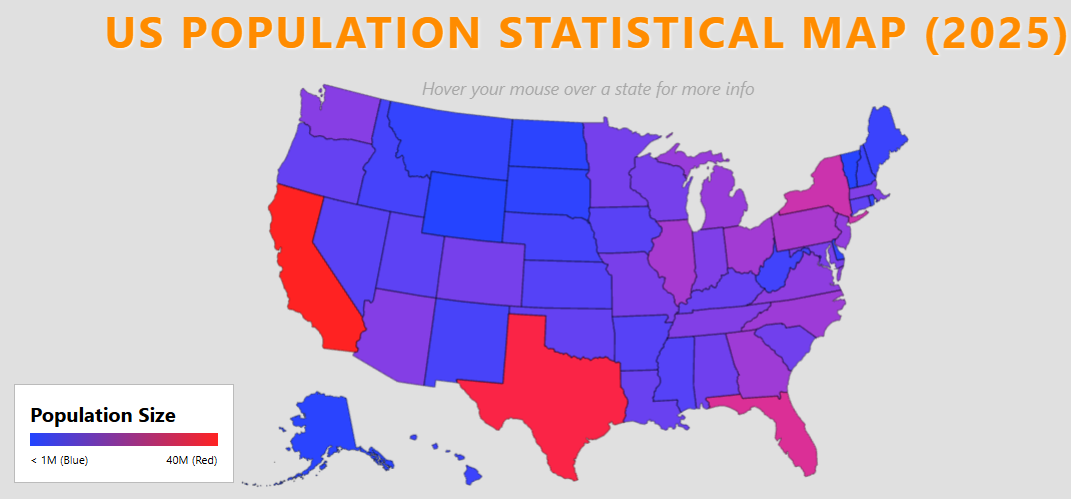
A 3D choropleth map of US population data — built to learn what GeoJSON and 3D mapping in a browser could do.
Most population maps are flat. The data is two-dimensional, the visualisation is two-dimensional, and there's nothing wrong with that — but I wanted to see if a 3D treatment would add useful information or just be decorative.
The US Population Map is the result of that experiment. State outlines extruded into 3D blocks, with height proportional to population. Hover over any state to see its demographics — total population, percentage of the national total, gender distribution. Click to lock the highlight. Click here to access.
What it is
A real-time interactive choropleth where the third dimension carries the population metric. California rises as a tall block; Wyoming sits flat. Hovering reveals the underlying data through ray-casting from the cursor into the 3D scene to detect which state's mesh is under the pointer.
The dataset is projected 2025 figures, with the demographic breakdown stored as metadata on each state's mesh — no external database needed, just rich geometry.
What stayed with me
The technical lesson was about GeoJSON parsing in 3D. GeoJSON is fundamentally a 2D format. Lifting it into 3D — extruding the polygons, mapping coordinates correctly, handling the projection — turned out to be more interesting than I expected. The same techniques would apply to mapping vibration data on a structural model, or temperature data on a thermal model, or strain data on a deformed mesh.
The design lesson was that the third dimension only earns its place when it carries information that the second dimension can't. Height proportional to population works because the eye is naturally drawn to taller bars. If I'd used height for something less primary — say, gender ratio — the visualisation would have been confused. One axis, one variable.
Part of the early experiments — learning how to lift 2D data into useful 3D visualisations.