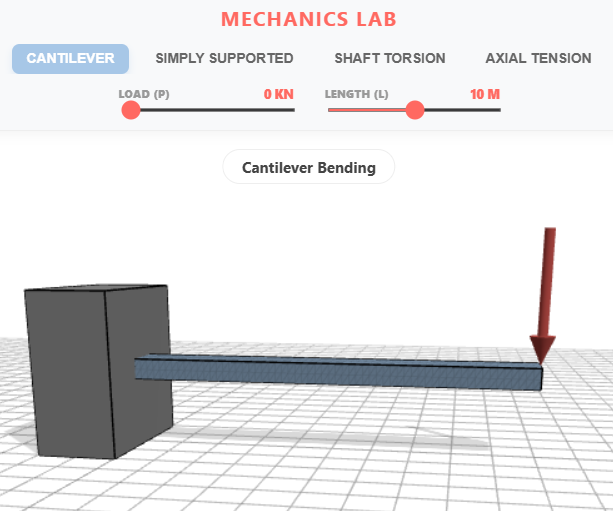
An early all-in-one prototype that explored four classical mechanics scenarios in one tab — the seed that grew into Tension & Moment and Tensile.
This was a prototype lab that tried to do four different things at once: cantilever bending, simply supported beams, shaft torsion, and axial tension. All in one page, all interactive, all updating in real time as you moved sliders.
The ambition was simple and probably too broad — I wanted students to see the four foundational structural mechanics cases side by side, with their deformations rendered against a ghost-wireframe of the undeformed shape. Toggle between modes, adjust load, length, torque, watch the Poisson effect appear. A unified mechanics teaching aid.
The lesson the experiment taught me was that a single tool trying to teach four scenarios at once does none of them as well as four focused tools could. The follow-up projects — Tension & Moment for full FEM beam analysis, Tensile for 2D truss work — each took one of those cases seriously instead of broadly. They're the descendants of this experiment. Click here to access.
What it is
A four-mode mechanics visualiser. Pick your scenario, adjust the parameters, watch the structure deform with the wireframe of its original shape overlaid for contrast. Useful as an early-semester teaching aid for introducing the four cases conceptually.
What stayed with me
The realisation that focused tools beat unified ones. Most CAD packages bundle dozens of analysis types into one application; that's appropriate for working engineers. For teaching, dedicated tools — one per concept — let you go deeper into each. The unified lab is a useful introductory survey; the specialist tools that came later are where the real engineering teaching happens.
Part of the early experiments — surveying the territory before settling into the focused engineering tools that followed.