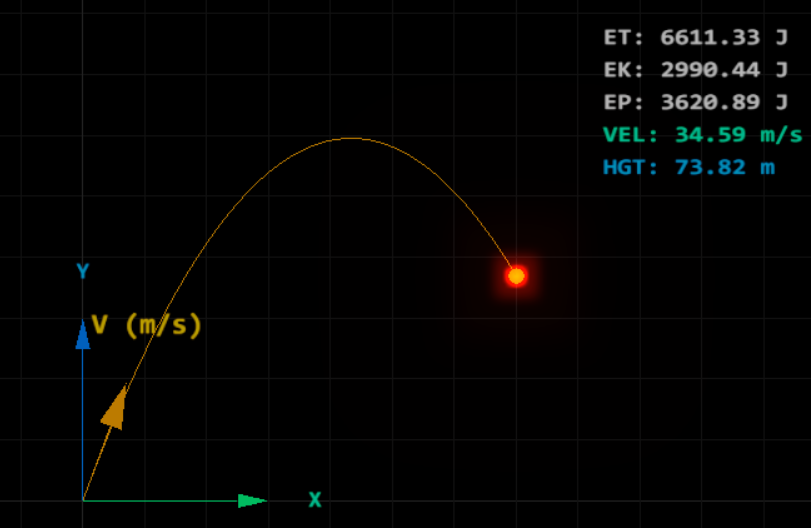
A real-time simulation of energy transfer in projectile motion — kinetic, potential, the moment one becomes the other.
Energy conservation is one of the most powerful ideas in physics. Total energy in a closed system stays constant. As a ball rises, kinetic energy converts to potential. As it falls, the reverse. The math is exact. The intuition, for students, usually arrives late.
This simulation tries to bring the intuition forward. The simulator from the Projectile Motion experiment was extended with real-time energy tracking — kinetic, potential, and total — visualised as the projectile moves.
Click here to access.
What it is
A 2D projectile simulator with energy visualisation. Set launch conditions, watch the trajectory, watch the energy bars on the side update continuously: kinetic going down, potential going up, total staying flat. At the peak, kinetic hits zero and potential is at maximum. At ground level, the inverse.
A pause button lets you freeze any moment to inspect the energy state. A peak-energy summary appears after each flight.
What stayed with me
The lesson was about invariants as teaching tools. The total energy bar — the one that stays flat throughout the flight — is the entire point of the simulation. It's the visual proof of the conservation law. A student watching it stay constant, even as kinetic and potential trade back and forth, is watching the law of physics happen in front of them. That's a different teaching experience from solving algebra exercises.
I kept this pattern in mind for the later vibration labs. Whenever there's a conservation law (energy, momentum, modal participation), visualising the invariant alongside the changing quantities makes the law tangible.
Part of the early experiments — and a pedagogical pattern that fed into the bigger engineering tools.