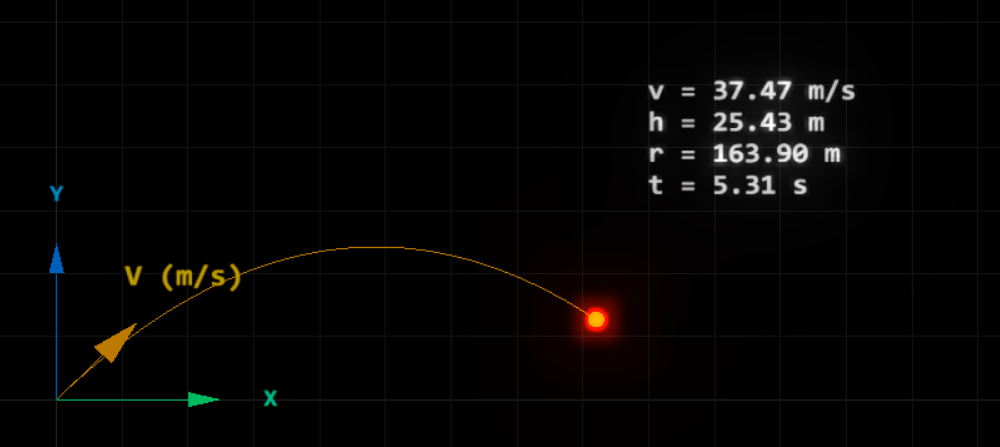
A real-time kinematic playground for the classical "ball thrown at an angle" problem — built for the moment a physics student finally sees what their equations describe.
Projectile motion is in every introductory physics curriculum. Initial velocity, launch angle, gravity, the parabolic trajectory that follows. The math is straightforward. The intuition takes longer to develop, because students rarely see the parameters move — they solve for a single trajectory on paper, compute a max height, compute a range, and move on.
This simulator inverts that. The parameters are the controls. The trajectory is the output. Adjust velocity or angle and watch the parabola change shape. Click here to access.
What it is
A simulator that takes initial velocity and launch angle as inputs and draws the resulting trajectory in real time. Numerical values for maximum height and total range appear as the simulation runs. A pause button lets you freeze the projectile mid-flight to inspect the state.
The aesthetic is a "computer terminal" — green-on-black, bloom effects, post-processing for a high-contrast look. Closer in feel to a physics workstation than a textbook diagram.
What stayed with me
The realisation that time-step integration matters more than you'd think. The simulator uses precise high-resolution time stamps to compute positions, rather than a frame-counter. The result stays accurate even when the browser drops frames — the projectile is at the right position for the elapsed time, not the elapsed frame count. That precision shows up later in the vibration labs, where physical accuracy under variable frame rate matters even more.
The pedagogical lesson was that interactivity is what turns a formula into intuition. A student who has solved fifty trajectory problems on paper has computed many answers. A student who has watched the parabola flatten as the launch angle decreases has seen what the answer means.
Part of the early experiments — establishing the interactive-physics-simulator pattern that the later labs were built on.