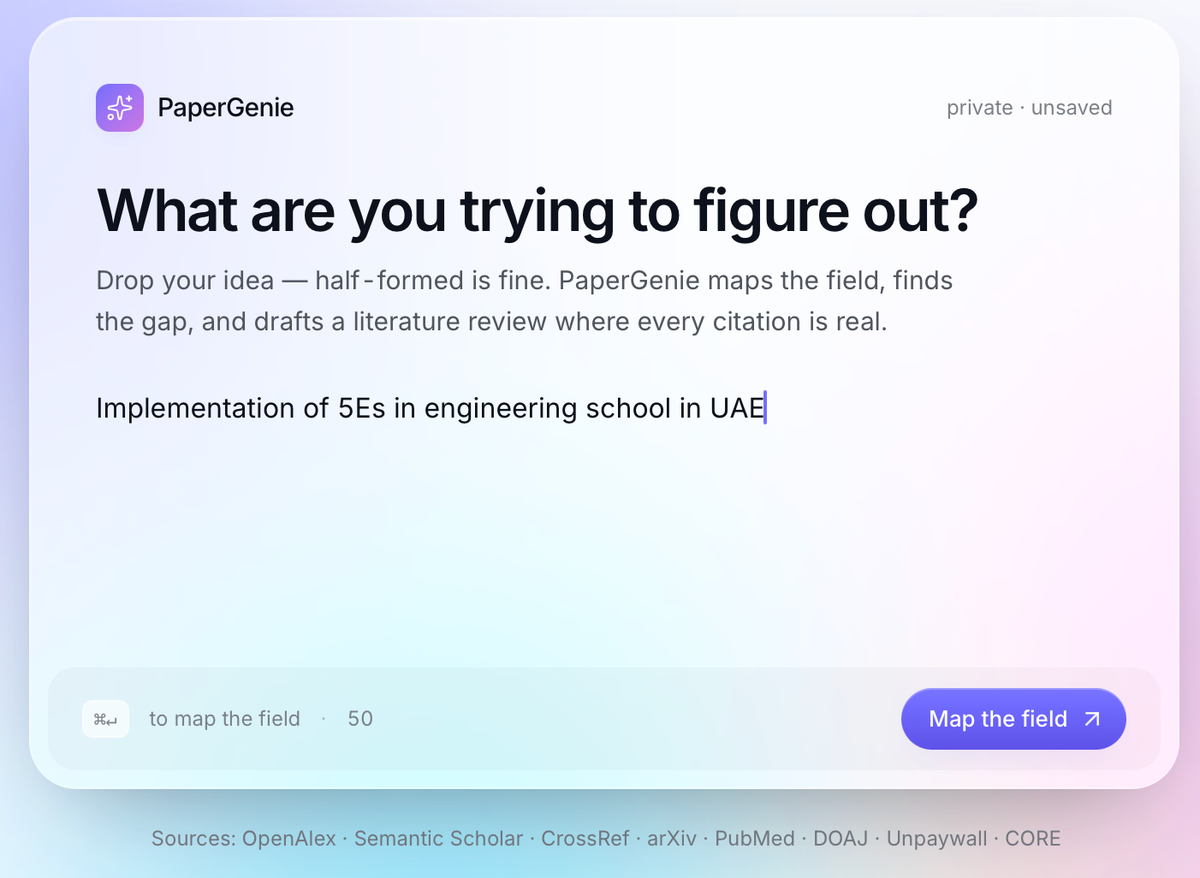
Built because I'm a researcher with a tight schedule, and I refused to keep auditing every AI-generated citation by hand.
I'm a professor with a tight schedule who still has to write papers. That combination puts me in a complicated relationship with AI research assistants in 2026.
Every modern AI tool will happily generate a confident-sounding literature review for you. Most of them will also lie to you. They invent citations. They attribute claims to papers that, if you go look, say nothing of the sort. They give you a 47% reduction in flexural stress that exists nowhere in the cited work. For a journalist this is annoying. For a researcher submitting to peer review, it is the end of the world.
PaperGenie is the tool I built because I refused to keep doing manual citation auditing every time I used AI to help me write.
Try it at here.
Who this is for
The audience is narrow and specific: faculty members who are time-poor and citation-strict. PhD supervisors who receive AI-assisted draft summaries from students and have to ask, every time, "but did you actually read the paper?" Anyone whose own credibility is the only thing standing between a hallucinated citation and a retracted paper.
Existing tools either generate confidently-wrong prose, or they require you to verify every citation manually — which defeats the entire purpose of automation. The space between "automated but unreliable" and "reliable but laborious" is where PaperGenie lives.
How it works
You feed PaperGenie a half-formed research idea, in whatever messy form your thoughts arrive in. It reads the idea, searches across eight scholarly databases in parallel, and gives you back three things.
First: a visual map of the field, with papers grouped into clusters and labelled by topic, so you can see at a glance where research is concentrated and where it's sparse.
Second: a list of genuine gaps in the literature — places where two concepts rarely meet, methods that haven't been tried in this corner of the field, or topics that were busy a few years ago and have quietly stalled.
Third: a literature review skeleton — draft prose with inline citations — where every cited claim has already been checked against the paper it points to. If a sentence can't be supported by the paper it cites, the sentence is removed before you ever see it.
It's a research assistant. The kind that doesn't take liberties.
The core idea
The pedagogy — if a research tool can have one — is that verification has to be wired into the pipeline, not bolted on as an afterthought.
Most AI research tools generate text and then offer a "fact-check this" button as an optional second step. That treats hallucination as a user problem. PaperGenie treats it as the system's problem to prevent. Every sentence in the generated output is paired with its claimed source, and an AI verifier reads both before deciding whether the citation actually supports the sentence. The user only sees what the verifier kept.
That single design decision shaped everything else. The corpus had to be large enough to draw from. The clustering had to be honest enough that you could see where the corpus was thin. The gap detection had to be conservative enough not to make up gaps where none exist. And the verifier had to be strict enough to catch confident fabrications without rejecting legitimate paraphrases.
There is one number — the verification threshold — that has to be set by someone with domain expertise rather than coding skill. Too lenient, and the verifier waves through claims that are merely adjacent to their citation. Too strict, and legitimate paraphrases get rejected. The default sits in the middle. Users can dial it tighter for peer review work, or looser for exploratory reading.
The moment I stopped doubting it
I tested PaperGenie on a topic I knew well — nacre-inspired hierarchical structures, the kind of research I had supervised a decade earlier. The skeleton came back clean. Then I noticed the diagnostic panel: 32 sentences kept, 13 dropped.
I opened the drop log. One of the removed sentences referenced "a 47% reduction in flexural stress" — confident, specific, exactly the kind of number a reviewer would flag. The cited paper, when I checked it, said nothing about flexural stress at all. The model had fabricated the statistic and attached it to a paper that talked about something adjacent.
Without the verifier, the number would have made it into the output. With the verifier, it didn't.
That was the moment I stopped thinking of PaperGenie as a research demo and started thinking of it as something I could actually trust to draft alongside.
What this is
PaperGenie is what I built because I needed it. It doesn't replace reading the papers yourself; nothing does, and nothing should. But it gets a researcher from a half-formed idea to a verified, mapped, gap-aware starting point in a few minutes instead of a few days. For a faculty member with a tight schedule, that gap is the difference between a literature review getting written and a literature review getting deferred.
If you're a faculty member, a PhD student, or anyone whose citations need to survive scrutiny: try it on a topic you already know well. The first thing you'll find is what it surfaced that you didn't. The second is what it didn't find, which tells you something useful about the blind spots of the federated databases.
You can use it at pgen.hilmybox.com. Bring a topic you care about. Bring skepticism. The tool was built for both.
Coming next
A tutorial article and YouTube video are in production: a walkthrough of how I built PaperGenie with AI coding agents, including the pipeline architecture, the verification logic, and the decisions that shaped the design. Subscribe to get it when it ships.