Ask a class what friction is and most students can answer. Ask them what the coefficient of friction actually measures, and the room usually goes quiet. The formula F = μN gets memorized, the worksheet gets handed in, and μ stays a symbol on the page instead of a number that does anything.
A physics tower game fixes that, because it lets students change μ and watch what happens. Here's the physics, and a short lesson you can run with a free browser game called Teeter. You may check it here.
What is the coefficient of friction?
The coefficient of friction, written as the Greek letter μ ("mu"), is a dimensionless number for how strongly two surfaces resist sliding past each other. It connects the friction force to the force pressing the surfaces together:
F_friction = μ × N
N is the normal force, and a larger μ means more grip.
Three points are worth hammering home, because they're where students trip up:
- μ belongs to a pair of surfaces, not to one material. Saying "the friction coefficient of wood" is incomplete. You have to specify wood on wood, wood on steel, and so on.
- Static friction, which resists the start of motion, usually has a slightly higher coefficient than kinetic friction, which resists motion that's already happening.
- For ordinary materials μ tends to land between 0 and 1. Zero is frictionless. Close to 1 is sticky. A few unusually grippy pairs go above 1.
That 0-to-1 span is what makes a stacking game such a useful demonstration. You can sweep μ across the whole range and see, at each setting, whether anything can stand up.
Why a stacking tower is really a friction experiment
A Jenga-style tower has no glue and no pins. The only thing keeping it upright is friction between the wooden faces. When you slide a block out, you are pulling against that friction directly. Pull a load-bearing piece, or yank too fast, and the balance gives way.
Conveniently, there are two separate friction relationships at work:
- Block on block, which sets how tightly the layers hold each other.
- Block on table, which sets how firmly the whole stack grips its base.
With real wooden blocks those numbers are fixed by the wood. In a simulation you can change either one while the tower is still standing, and that is the part that makes it teachable.
Teeter: a tower game with a friction slider
Teeter is a 3D block-pulling game, inspired by the classic stacking game, that runs in any modern browser on a phone, tablet, or computer. It is built on a real physics engine, so gravity, collisions, and friction are genuinely simulated rather than faked with animation.
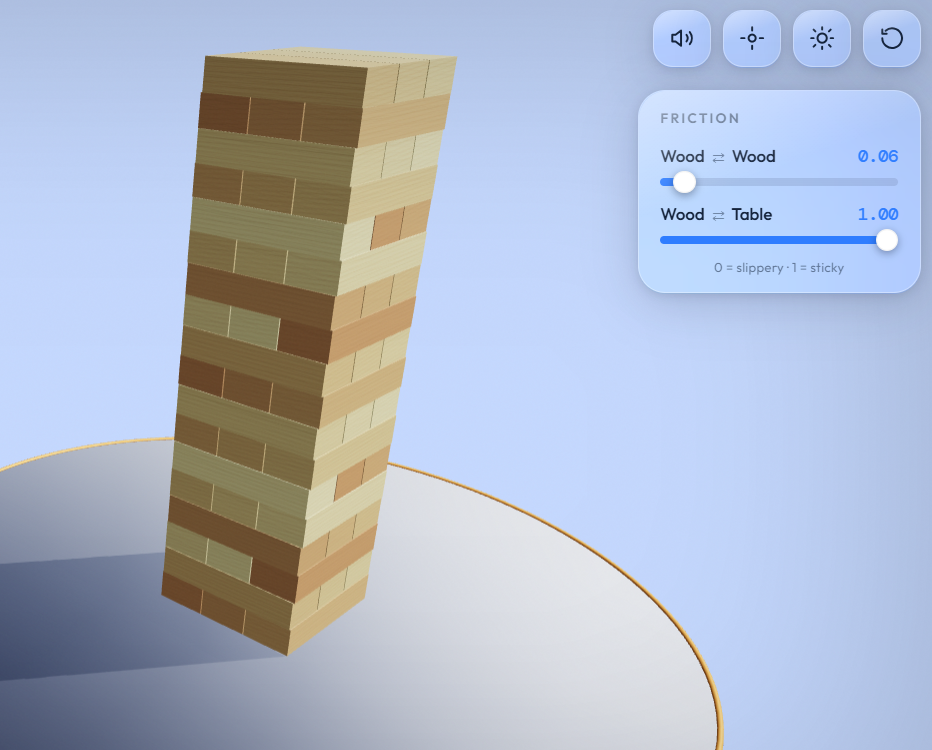
The piece that matters for a friction lesson is the control panel, which holds two sliders:
- Wood ⇄ Wood sets the coefficient of friction between the blocks, from 0.00 (slippery) up to 1.00 (sticky).
- Wood ⇄ Table sets the friction between the bottom layer and the platform, on the same scale.
Move a slider and the new value takes effect immediately on the tower that is already there. No reset, no reload. A structure that was solid a second ago starts to sag, or the reverse. You pull blocks by dragging with a mouse or a finger, and the wood-clack sound effects get louder with harder impacts, which quietly tells you when friction is losing the fight.
A short friction lesson you can run with it
This works on a projector as a teacher demo, or on student devices as a guided exploration. Budget about ten minutes.
Start with the question. Let the tower settle at its default settings and ask what is holding it up. There is no glue, so the answer has to be friction. It is a small thing, but making students name the force before they touch anything pays off later.
Take the friction away. Drag Wood ⇄ Wood to 0.00. The layers lose their grip and the tower slumps almost at once. This is the moment that lands. With μ at zero there is no force resisting the blocks sliding apart, so nothing can stay stacked. Ask why you couldn't build anything at all in a frictionless world.
Hunt for the threshold. Rebuild, then raise Wood ⇄ Wood slowly from zero. Have students watch for the value where the tower first holds reliably. That number stands in for a real idea: every gripping task, from car tires to climbing shoes, needs some minimum coefficient of friction to work.
Pull the two surfaces apart. Set Wood ⇄ Table near 1.0 but keep Wood ⇄ Wood low. The base stays put while the upper layers slide loose. Then swap the settings. The point sinks in on its own. Friction depends on which two surfaces are touching, and one machine can have very different coefficients at different joints.
Tie it back to real numbers. Compare the slider values to measured coefficients for real materials, listed below, and ask which setting best matches actual wooden blocks.
Putting real numbers on the slider
Real surfaces have measured coefficients of friction. The values below are approximate static figures, since they shift with finish, moisture, and wear, but they give the slider a reality check.
| Surface pair | Approx. coefficient of friction (μ) |
|---|---|
| Teflon on Teflon | ~0.04 |
| Ice on ice | ~0.05–0.1 |
| Wood on wood | ~0.25–0.5 |
| Steel on steel (dry) | ~0.5–0.8 |
| Rubber on dry concrete | ~0.6–0.9 |
| Glass on glass | ~0.9–1.0 |
Real wood on wood comes out around 0.3 to 0.5, which is roughly where Teeter feels most like the physical game. That is low enough that a block will come free if you are careful, and high enough that the tower forgives a small mistake. Drop well below it and the game becomes nearly unplayable. Push well above it and it is too easy to win.
Why letting them break it works
You don't need a research paper to know that a student who sets μ to zero and watches a tower fall will remember more than one who copied F = μN off the board. The useful thing about a simulation is the loop it sets up. A student guesses what a setting will do, drags the slider, sees whether the tower agrees, and adjusts their thinking. Once μ is a number they control instead of a constant in a problem, the equation stops being trivia and starts describing something they just caused.
Frequently asked questions
What is the coefficient of friction in simple terms? It is a number (μ) that tells you how strongly two touching surfaces resist sliding. Multiply it by the normal force and you get the friction force, written F = μN. A higher μ means more grip.
Why does a Jenga-style tower need friction to stand? The blocks are held together only by friction between their surfaces. With no friction, nothing resists the layers sliding apart, so the tower collapses. You can show this directly by setting the friction slider to zero.
What is a realistic coefficient of friction for wood on wood? Roughly 0.25 to 0.5 for dry wooden surfaces, though it depends on the finish and on moisture.
Can the coefficient of friction be greater than 1? Yes. Most everyday pairs fall between 0 and 1, but very grippy combinations such as some rubbers can go higher.
Is Teeter free to use in class? Yes. It runs in any modern browser with nothing to install, on phones, tablets, and computers, so it works as a teacher demo or a student activity.
Try it
The quickest way to understand the coefficient of friction is to set it to zero and watch a tower fall over. Open Teeter, drag the Wood ⇄ Wood slider down, and let the physics make the point.
Teeter is an independent project by hilmybox.com, inspired by the classic block-stacking game. JENGA® is a registered trademark of Pokonobe Associates. Teeter is not affiliated with or endorsed by the trademark owner.