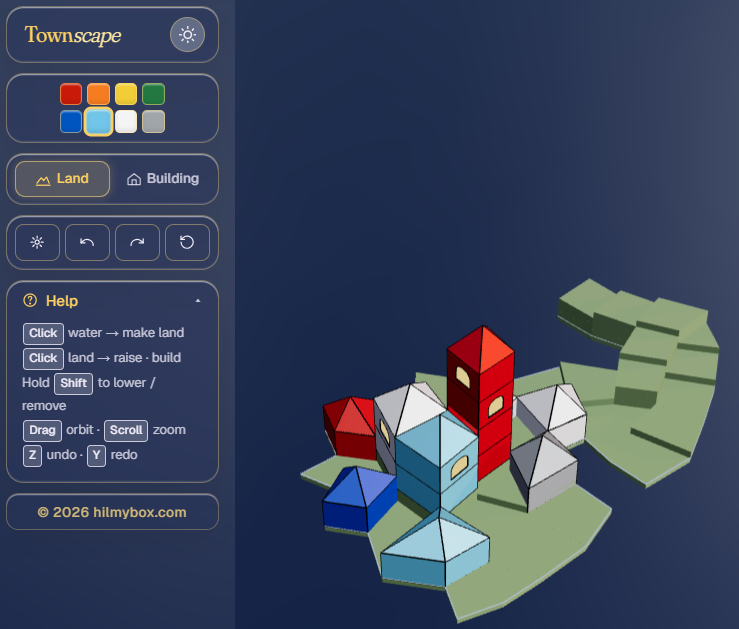
I wanted to build a Townscaper. So I built Townscape — a small, charming village builder you can play in a browser tab.
I wanted to build a Townscaper. Not exactly — that's a finished, perfect thing made by Oskar Stålberg, and trying to clone it line for line would be a waste of everyone's time. But I wanted that feeling: drop a tile, see something charming appear, no goals, no pressure, just the gentle pleasure of building.
So I started a project called Townscape — a glass-and-light village builder that runs in any modern browser.
Play Townscape here — runs in any modern browser, source on GitHub.
Who this is for
The audience is anyone who finds it satisfying to drop tiles on a grid and watch a small village appear. Players who have spent hours with Townscaper, Islanders, or Dorfromantik. Designers and architects who like to think in volumes. Engineers who want a quiet five-minute break that isn't on their phone. Or anyone who just wants something gentle on a screen.
How it works
You're looking down at a grid of irregular cells on a flat water surface. Click a water cell — it becomes land. Click the same cell again — it raises into a small hill. Switch to the building tool and you can stack coloured blocks on any land cell to build houses, towers, or anything in between. Switch the colour. Shift-click to remove. Undo with Ctrl-Z. There is no goal. There is no score. There is no time limit.
The village just gets prettier as you build it. Pyramidal roofs auto-cap your towers. Buildings that sit next to each other share walls cleanly. Switch from Daylight to Twilight and every window glows warm yellow against a dusk-blue sky.
The core idea
The principle is the building is the point, not the win condition. Most "city builder" games tie construction to a resource economy: collect this, spend that, hit a milestone. Townscape has none of that, because it isn't trying to be a strategy game. It's trying to be a particular feeling.
The grid isn't a uniform hex pattern — it's a relaxed irregular mesh, where cells start as a regular pattern and slowly drift toward organic shapes after several iterations of smoothing. The result is cells that look hand-drawn, not machine-generated. No two cells are quite the same. The whole village feels harmonious without feeling identical.
The buildings are computed at click time from real procedural geometry. No premade models. Every wall, every roof, every window is generated to fit whatever cell you placed it on. The Twilight theme isn't just a darker palette — every window gets a small emissive panel behind it that lights up only when the sun goes down. The buildings become lanterns.
Every decision was about making one specific feeling reproducible: the gentle satisfaction of building something charming for no reason at all.
The moment the village becomes a place
The reason for building this is a moment that happens around the twentieth block. Early on, you're placing blocks to see what they do. The village looks like blocks. Then you switch to Twilight, the windows light up, and what was on the screen stops looking like a grid of geometry and starts looking like a place — somewhere a person could live, somewhere with light coming from somewhere with a name.
That's the moment Stålberg's original captured so well, and the one I was chasing in Townscape. It happens earlier with some players, later with others. But it happens.
What this is
Townscape is a small thing built on purpose. Not a game, not a tool, not productivity software. A piece of digital architecture you can place on a screen, drop tiles into, and watch a village appear. Free. No account. Open source on GitHub.
It's a small argument that not every project needs to be useful. Some projects earn their keep by being delightful.
Coming next
A tutorial article and YouTube video are in production: a walkthrough of how Townscape was built with AI coding agents — the relaxation algorithm that gives the grid its hand-drawn quality, the procedural building geometry, the window-emission trick that lights up Twilight mode, and the small decisions that made it feel like a place instead of a grid. Subscribe to get it when it ships.