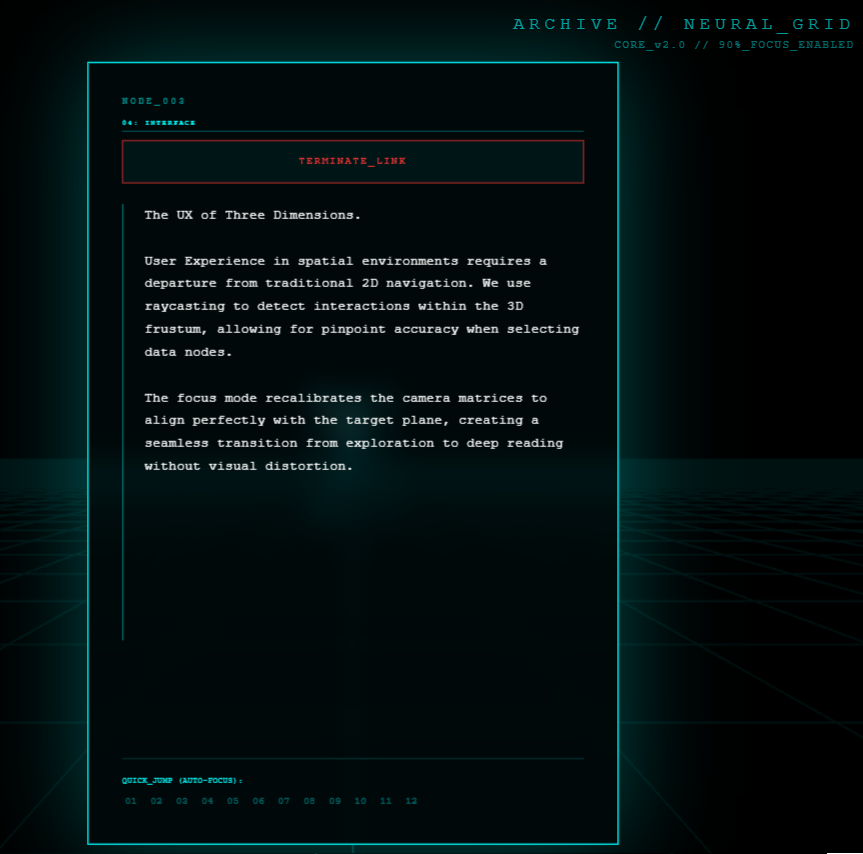
A second portfolio experiment — an "infinite" 3D neural grid where each work occupies a coordinate in space rather than a row in a list.
The Digital Nexus experimented with a rotating cube as a portfolio interface. Holodeck was the more ambitious follow-up: an entire 3D neural-grid space, where each project lived at a specific 3D coordinate, and navigation through the portfolio meant flying through space toward whatever you wanted to look at.
It's a small piece of spatial UI design — the kind of interface design that doesn't quite belong on most websites but is interesting to explore in case any of it suggests something useful elsewhere.
Click here to access.
What it is
A dual-rendered 3D environment combining a high-performance 3D engine with the browser's standard text rendering. Project content lives in the 3D space — coordinates, focus targets, descriptions that type themselves onto surfaces when you navigate near them. Two modes: free exploration (you can fly anywhere) and focus mode (the camera locks onto whatever project you've selected).
The aesthetic is "spatial computing data terminal" — sparse, glowing, sci-fi-adjacent without being kitsch.
What stayed with me
The technical insight was the value of dual rendering pipelines. Some content is best as a 3D mesh (the grid, the structural elements). Other content is best as flat HTML (the text descriptions, the navigation UI). Combining them — 3D engine for the geometry, regular DOM for the readable text — gave each format its proper role. That hybrid approach showed up in several later projects whenever a 3D scene needed proper text.
The broader observation was that spatial UIs aren't always the right answer. They feel cool. They photograph well. They rarely improve task efficiency over a well-designed flat list. Holodeck was useful for me to build, but it confirmed something I'd suspected: most portfolios are better off as galleries. The spatial framing is a separate genre, not a universal upgrade.
Part of the early experiments — exploring the spatial-UI space and figuring out where it does and doesn't earn its place.