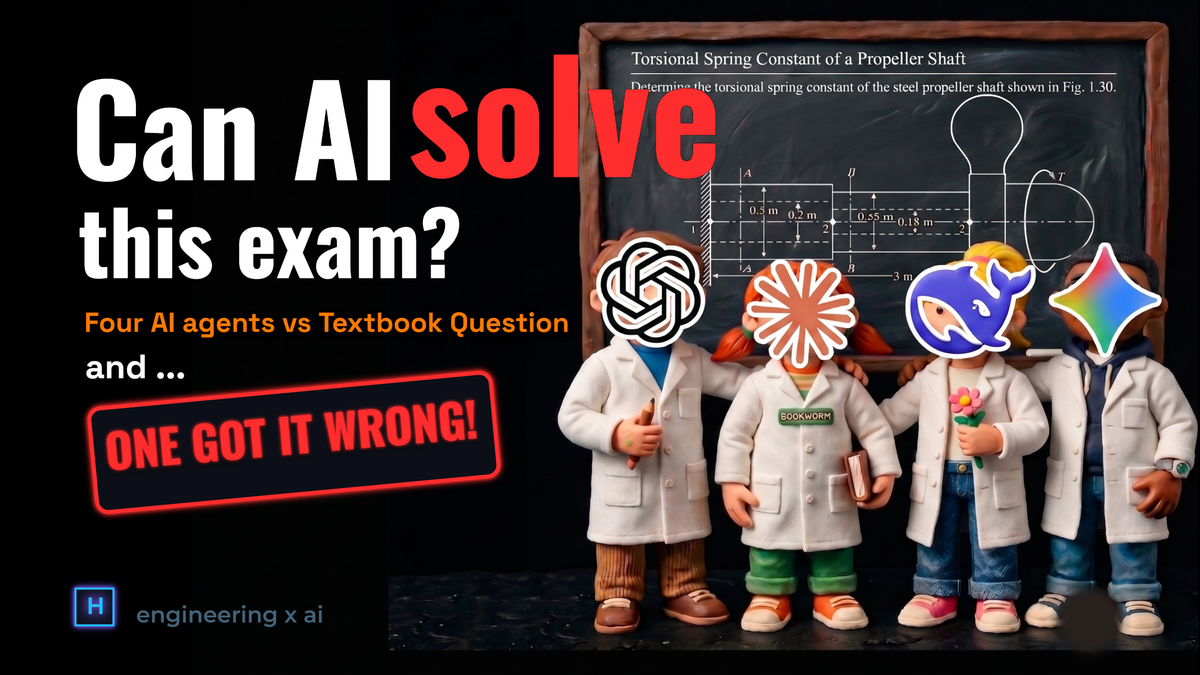
I gave four AI models — **DeepSeek, Gemini, ChatGPT, and Claude** — the same engineering exam question: find the torsional stiffness of a stepped, hollow steel shaft, straight from Rao's *Mechanical Vibrations*.
Three of them nailed it. They landed on **6.60 × 10⁶ N·m/rad** — basically the exact textbook answer.
One of them didn't. DeepSeek came back **about twelve times too low.**
Here's the strange part: its math was *perfect.* The mistake wasn't in the calculation — it was that DeepSeek couldn't read the figure. So it quietly assumed a solid shaft, invented its own dimensions, and flawlessly solved a problem that didn't exist.
That's the real lesson. AI doesn't fail at the math. It fails at **what it can't see** — and it fails *confidently*, with an answer that looks completely right. So when you use it: verify the inputs, not just the answer.
I recorded the whole test — all four models, the full working, and the moment the twist becomes obvious. **Watch the detailed breakdown on YouTube:**