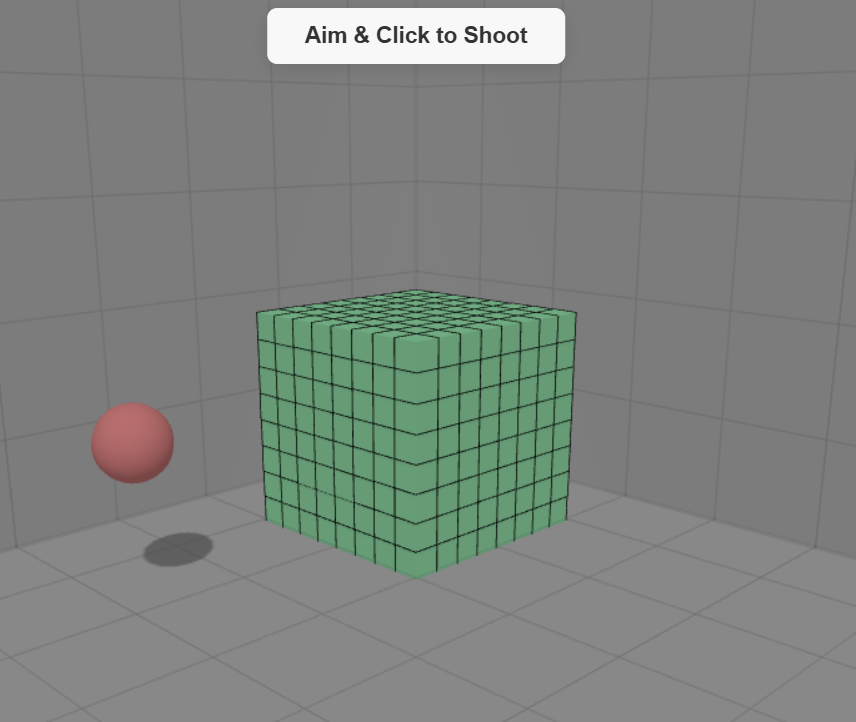
An early exploration into real-time rigid-body physics in the browser — built for the satisfaction of watching things break.
Browser-based physics simulations used to require heavy native software. By 2025, that had quietly changed: a fast physics engine, integrated with a 3D rendering library, could run hundreds of independent rigid bodies in real time on a mid-range laptop.
Cube Disintegration was an experiment to find out how many.
A target cube is voxelised into a configurable mesh — a hundred chunks, five hundred, more if your machine can handle it. A projectile flies in. The chunks scatter, collide, settle. Gravity, friction, broad phase collision detection — all running in the browser, at sixty frames per second. Click here to access.
What it is
A destruction sandbox. Adjust the mesh resolution, the projectile mass, the projectile speed. Fire. Watch the cube come apart. The point is the physics, not the violence — it's a stress test wrapped in a satisfying interaction.
What stayed with me
The discovery that browser physics had caught up to native applications for problems of this size. Five hundred independent rigid bodies, properly integrated, with proper collision detection, all running in a browser tab — that wasn't possible a few years earlier. The lab confirmed the platform could carry the weight, which opened the door to all the simulation tools that came after.
Also the technical lesson: broadphase collision detection matters enormously. The naive collision check chokes around fifty chunks. With proper broadphase pruning, the same hardware handles ten times more. That distinction shows up in every physics-heavy project since.
Part of the early experiments — finding out what the platform could carry before committing to the bigger builds.