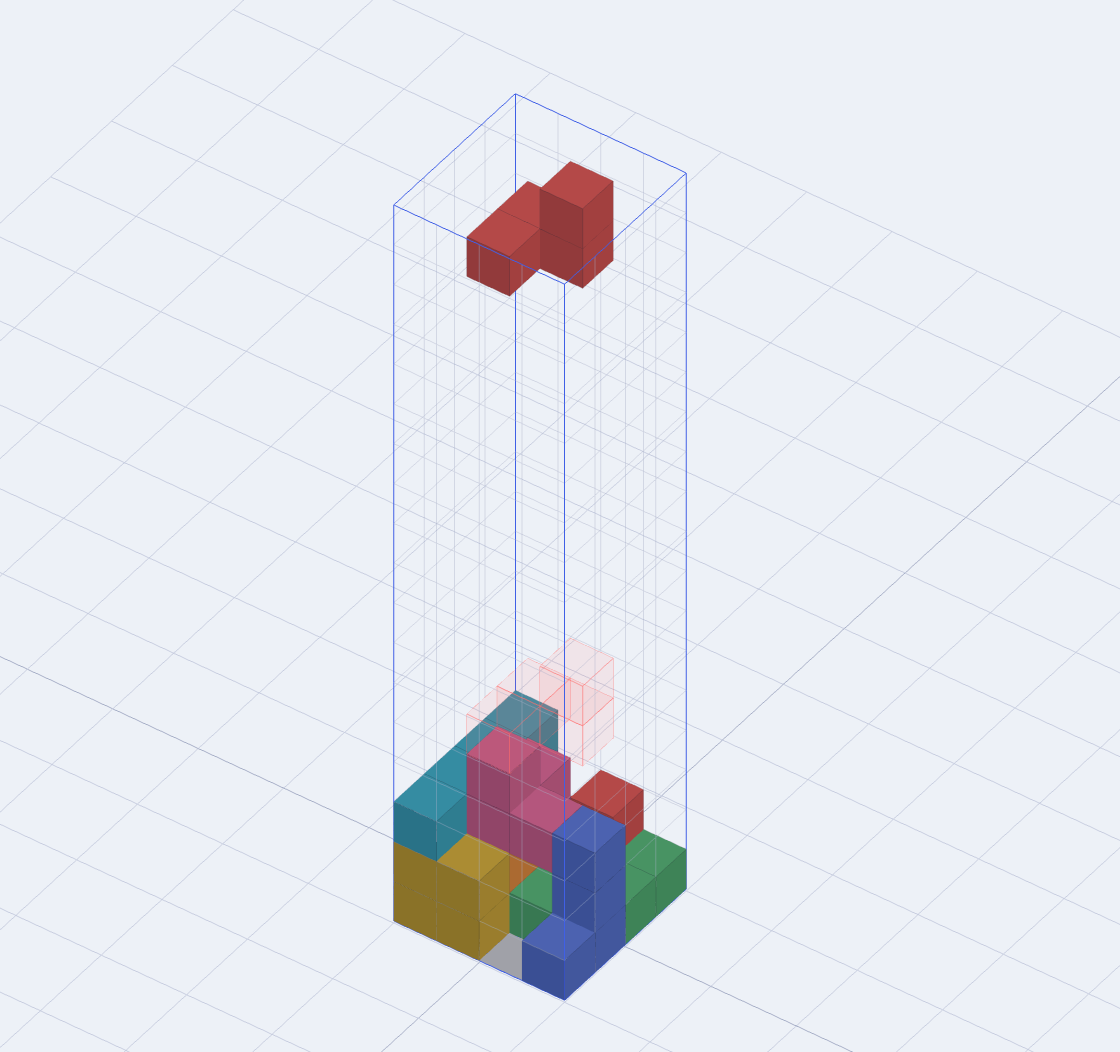
The original spatial puzzle, extended into the third dimension, in one HTML file.
Tetris is one of the most successful pieces of teaching software ever shipped, and it doesn't know it. Forty years of players have trained their spatial reasoning by trying to rotate L-shaped pieces into gaps in real time. The skill transfers — psychologists have measured it. Tetris players are better at mental rotation tasks. Tetris is, accidentally, a spatial-reasoning textbook.
What if it were three-dimensional?
Cubefall 3D is what that question turned into. Same falling blocks, same line-clearing rules — but now the well is a 4×4×12 column, the pieces are tetracubes instead of tetrominoes, and you have to rotate them around three independent axes instead of one.
Play Cubefalls 3D here — runs in any modern browser, mobile or desktop, ships as one HTML file under 100 KB.
Who this is for
The audience is anyone who likes spatial reasoning, anyone who has ever lost an evening to classic Tetris, and anyone who wants to find out what their brain does when the rules they know get extended into a new dimension. Engineering students get a workout. Game players get a fresh challenge. Casual players get a familiar puzzle in an unfamiliar space.
How the game works
A piece falls from the top of the well. You can rotate it around any of three axes — pitch, yaw, or roll. You can shift it horizontally on either floor axis. When it lands, it locks in place. When a horizontal layer fills completely with cubes, the layer clears and everything above it falls down by one. Multiple layer clears at once score higher. The game ends when the well overflows.
That's it. You can switch between four camera modes — isometric, perspective, top-down, or auto-orbit — depending on what feels easiest for the piece you're trying to land. There's a day mode and a night mode. The score saves locally. No login, no leaderboards, no ads.
The core idea
The principle is that classic Tetris worked because every constraint mattered. The pieces, the rotations, the well width, the line-clear rule — every one of those exists because changing it makes the game worse. The challenge of extending Tetris into 3D was honouring that principle: which constraints needed to stay, and which needed to evolve?
The 4×4 well floor stayed narrow on purpose. Wider would dilute the difficulty. The 12-cell height stayed shallow on purpose. Taller would feel like a tower, not a well. The eight tetracube shapes are the genuine 3D extension of the seven tetrominoes — discovered by extending the 2D pieces into the third dimension with no liberties taken. The wall-kick rules were redesigned from scratch for 3D because the 2D ones don't generalise. Every decision was what would the original designers do, if they had been working with a third axis from the start?
What the game actually trains, accidentally, is the same mental rotation muscle classic Tetris trains — but in three dimensions instead of one plane. The skill is harder. The transfer is real.
The moment three rotations become one
The reason for building this is a moment most players hit somewhere around their tenth game. Early on, you rotate pieces by trial: tap pitch, tap yaw, see what happens, decide. The rotations feel sequential. Then something shifts. You start seeing the rotated piece before you press anything. You know what the L-tetracube looks like with its long arm rotated 90° around Y because you've started keeping a mental model of the piece itself, not just its current screen pose.
That moment is the same one classic Tetris players hit forty years ago. It just takes longer in 3D, because the space is larger.
What this is
Cubefall 3D is a puzzle game and an unintentional spatial-reasoning trainer. The whole game ships as one HTML file under 100 KB — small enough to fit comfortably in an email. No app store. No account. No payment. Open it in a browser and play.
It's also a small experiment in what classic games would look like if the people designing them in 2026 could ship to any device in the world without a build step. The answer turns out to be: not bad.
Coming next
A tutorial article and YouTube video are in production: a walkthrough of how Cubefall 3D was built with AI coding agents — including the 3D rotation math, the wall-kick system, the 7-bag random generator extended to 3D, and the procedural audio engine that generates every sound from oscillators. Subscribe for when it ships. 1win kenya