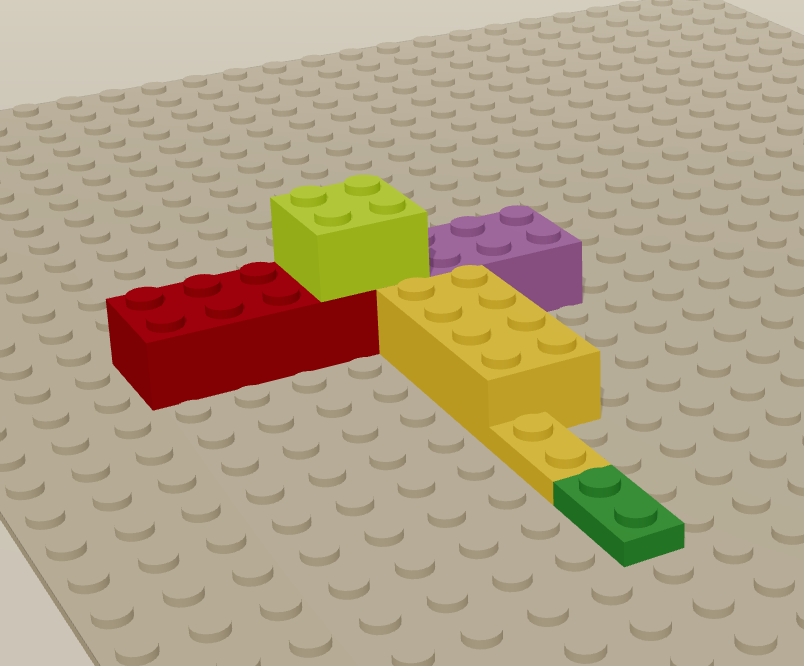
A single-file 3D builder for people who like building things for the joy of building things.
There's a particular pleasure in placing one LEGO brick next to another and watching a shape emerge. Most adults remember it. Most engineers I know became engineers partly because of it. The pleasure is small and specific and it has very little to do with technique.
briques is what happens when that pleasure gets a browser tab.
Open briques here — runs in any modern browser. No app store, no account, one HTML file.
Who this is for
The audience is anyone who likes building things. Children who grew up with LEGO and never quite outgrew it. Architects and product designers who think in blocks. Engineers who want a five-minute creative break between meetings. Or anyone who has ever caught themselves arranging objects on their desk into something that looks intentional.
How it works
You're standing at a workbench in an infinite room. In front of you is a large grey baseplate. Above it floats a brick, hovering wherever your cursor points, ready to land on the next stud below it. Click. The brick clicks into place.
Pick a different brick from the palette. Pick a different colour. Build whatever you want. There's no goal, no score, no timer, no clearing of the board. Save your build to a slot, name it, come back to it later. Export it as a file if you want to take it elsewhere.
That's the whole tool. Build something charming, and the workbench will be there the next time you open the page.
The core idea
The principle is no friction between the impulse and the brick. When you want to build something, the time between thinking about it and watching a brick land in front of you should be zero. No load screen, no tutorial, no account creation, no payment wall. Open the page. Place the first brick. The rest follows.
Every design decision served that one principle. The brick palette uses real Pick-A-Brick geometry, so a 2×4 brick in briques is the exact proportions of a 2×4 brick in the box on your shelf — your spatial intuition transfers directly. The stud-snapping is exact: bricks click onto studs, not into approximate positions. The collision detection means two bricks never overlap, never appear to overlap, and never need a fudge factor. The materials are matte ABS plastic, not lacquered resin, because real LEGO is matte. The lighting is a warm sun and a cool sky, because real workshops have windows.
briques is a small argument that browsers can do this now. A real-time 3D builder with snap-correct placement, soft shadows, an archival typographic identity, and a procedurally-synthesised click sound on every brick — all in one HTML file you can email to your nephew.
The moment the building becomes the point
The reason for building this is a moment that's harder to articulate than the engineering articles. You stack a few bricks. They start looking like something. You pick a different colour for the next brick — not for any plan, just because it feels right. Twenty minutes later you have a tiny structure on your screen that wasn't there before, and you can't quite remember what you were going to do with the afternoon.
That's what builders feel like. briques exists to put that feeling in a browser tab.
What this is
briques is one HTML file, ships from any web server, runs on any modern browser, builds anything you can think to build out of real-proportioned LEGO bricks. No store. No installer. No update prompt. The session autosaves. Your builds are yours.
It's a tool, but mostly it's an invitation: when was the last time you built something for no reason?
Coming next
A tutorial article and YouTube video are in production: a walkthrough of how briques was built with AI coding agents — including the stud-snapping math, the collision detection on the integer grid, the custom slope-brick geometry, and the small design decisions that made the workbench feel like a workbench. Subscribe to get it when it ships.