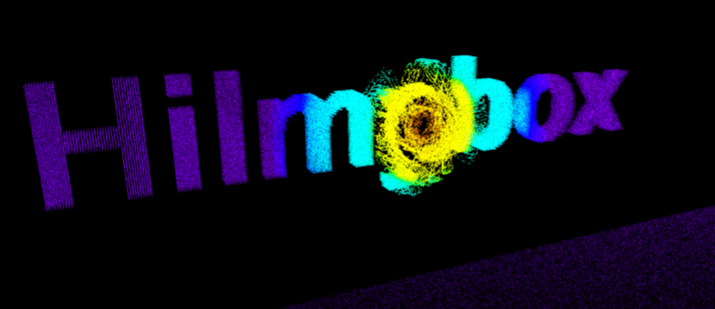
Type a word. It explodes into a hundred thousand particles. Then play with the physics.
There's an old browser-toy genre that almost nobody builds any more — sandboxes with too many particles, doing physically implausible things, that you push around with your mouse for ten minutes and then close the tab. They served no purpose. They were never trying to. They existed to be played with.
I missed them. So I built one.
Try it here — runs in any modern browser, works on tablets, scales from a hundred thousand to three hundred sixty thousand particles depending on your hardware.
Who this is for
The audience is anyone who likes pushing particles around. People who remember Flash-era browser toys. Front-end developers curious about GPU-driven particle systems. Anyone with five minutes and no particular agenda.
How it works
You type a word into the box. The system samples the pixels of the rendered word and assigns each white pixel a target position in 3D space. A hundred thousand particles flow toward those positions, forming a 3D version of your text floating in space. Then you can interact with it.
A dozen physics modes are available. Click and drag to attract particles toward your cursor. Switch to repulsion and they scatter. Try Black Hole and they fall inward and accelerate. Galaxy Spiral makes them swirl around an axis. Fluid Vortex applies a torque field. The Heatmap mode colours each particle by how strongly the physics is affecting it, so you can see the influence radius as a warm-to-cool gradient through the cloud.
Touch interactions work too. Single-finger drag for the primary effect. Multi-touch for variations. The audio engine generates ambient tones that respond to the particle activity.
The core idea
The principle is no goal, no point, no productivity. The browser is overwhelmingly used for tools — email, documents, calendars, design software, coding environments. The best browser toys take the same engine that drives those serious tools and use it for nothing. The playground is a small argument that nothing is a legitimate use of capable hardware.
The technical implementation is genuinely impressive — hundreds of thousands of particles updated and rendered every frame, GPU-accelerated, on a mid-range tablet. The number is large because it produces a cloud rather than a sparse field. Particles below ten thousand look like points; above a hundred thousand they start to look like material. Material that flows, swirls, and responds to your hand.
The interaction palette is wide because no single physics mode is right for every mood. Some days you want to repel. Some days you want to swirl. The lab provides options without making you choose one.
The moment a hundred thousand particles becomes one thing
The reason for building this is a moment that happens about ten seconds in. You type your name. The particles assemble into your name in 3D. You drag your finger across them. They flow out of the letters and back into them, like water disturbed and returning to stillness. The hundred thousand individual particles stop registering as particles and start registering as a single substance.
That's the same moment kids have when they discover sand. The substance has a behaviour. The behaviour is interesting. You don't need anything more from it.
What this is
A browser-toy. A particle sandbox. Three hundred sixty thousand things you can push around with your hand. Free, no account, runs on anything modern. Built for no purpose except that the purpose was missing.
Coming next
A tutorial article and YouTube video are in production: how this playground was built with AI coding agents, including the GPU particle pipeline, the text-to-position mapping, and the physics mode library. Subscribe for when it ships.