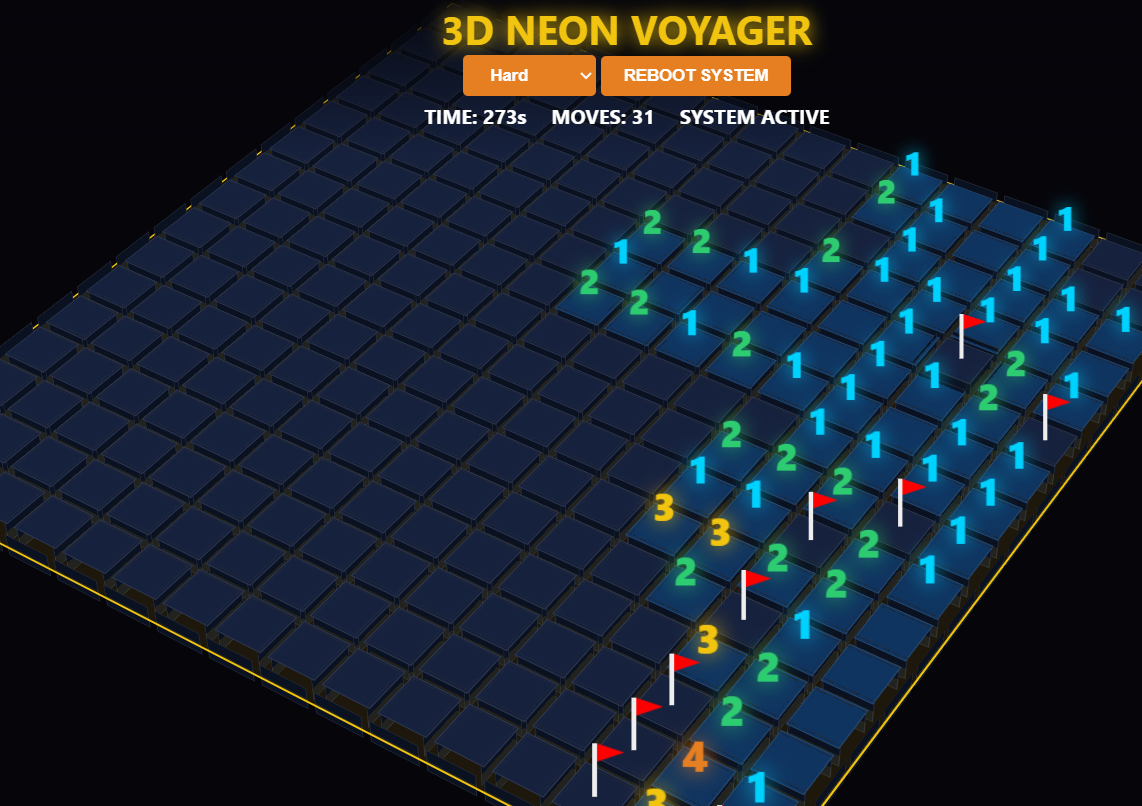
The classic logic game, presented in a rotatable 3D world — where the spatial-navigation challenge adds a new dimension to a familiar puzzle.
Minesweeper is a 2D game with a 2D mental model. You scan the board for clues, count neighbours, deduce safe cells. The board never moves. Your viewpoint never moves. The puzzle is purely about logic.
What happens if you take the same logic puzzle and put it in a 3D space, with a camera that rotates freely around the board?
It turns out the puzzle gets harder. Not because the logic changes — the rules are identical to classical Minesweeper. But because you now have to navigate the board through 3D space, and that adds a layer of spatial reasoning on top of the logical reasoning. Reading a board from a fixed top-down view is one skill. Reading it while the board tilts and rotates around you is a different one.
Play it here — runs in any modern browser. The whole board sits in 3D space, and the camera rotates with your mouse.
Who this is for
The audience is anyone who likes Minesweeper and wants to see how the puzzle feels with a 3D camera. Anyone training their spatial navigation skills — the ability to orient yourself in a 3D environment, find what you're looking at from different angles, build and maintain a mental map of a rotated space. Engineering students whose work involves moving cameras around CAD models. Anyone who works with 3D viewports for a living and is curious how the skill carries over to a familiar puzzle. This is part of the same spatial-awareness series as Umbra, Lattice, 3D Sudoku, and 3D Tic-Tac-Toe — different mechanic, similar workout.
How it works
The rules are unchanged from classical Minesweeper. A grid of cells, some containing mines. Click to reveal what's under a cell. If it's a mine, you lose. If it's a number, that's the count of mines in adjacent cells. If it's empty, the game flood-fills the surrounding empty area. Right-click (or long-press on mobile) to flag a suspected mine.
The change is that the board sits in 3D space. The cells are individual 3D cubes, slightly raised above the board plane. The camera orbits the board freely — drag to rotate, scroll to zoom. Numbers and flags stay readable regardless of camera angle, because each label counter-rotates to keep facing the viewer.
The 3D framing is the entire change. Same logic. Different perception.
The core idea
The principle is that the same logical puzzle can produce different cognitive demands depending on how you present it. A 2D grid viewed from above is the lowest-friction version: every cell is at a known, fixed screen position, and your eyes always know where to look. The same grid viewed through a rotatable 3D camera is harder, because you have to track where each cell is in your current view in addition to what's logically true about it.
That tracking — orienting yourself in a 3D space, keeping a mental map of where each clue is located as the camera moves — is a separate skill from the deductive logic of Minesweeper. Most people who can solve hard Minesweeper levels in 2D can also solve them in 3D Neon Voyager, but they're slower. That slowness is the spatial-awareness penalty: the brain is doing extra work to maintain orientation.
For someone who works in 3D environments — CAD modellers, animators, anyone who navigates a 3D viewport for a living — that extra work is normal. For most people it isn't. Playing 3D Neon Voyager regularly is a small workout for the navigation muscle, embedded in a familiar puzzle.
The moment 2D becomes navigated 3D
The reason for building this is a moment that happens about a minute into the first game. You've revealed a few cells. You rotate the camera to see a different angle of the board, and you realise you've lost track of which clue belongs to which area. The numbers are still visible. The flags are still placed. But your mental map of the board has reset, because the visual map has rotated.
That's the navigation penalty kicking in. After enough games, the penalty shrinks — your brain learns to maintain its mental map through camera rotations, and the puzzle starts feeling fast again. That adaptation is the spatial-awareness skill in action.
What this is
Classical Minesweeper, presented in a freely-rotatable 3D environment. Same rules, different viewing experience, additional spatial workload. Part of the spatial-awareness series alongside Umbra, Lattice, 3D Sudoku, and 3D Tic-Tac-Toe. Free, no account, runs in any browser.
Coming next
A tutorial article and YouTube video are in production: how this game was built with AI coding agents, including the CSS 3D cube construction, the camera rotation handling, and the billboard trick that keeps numbers readable. Subscribe for when it ships.