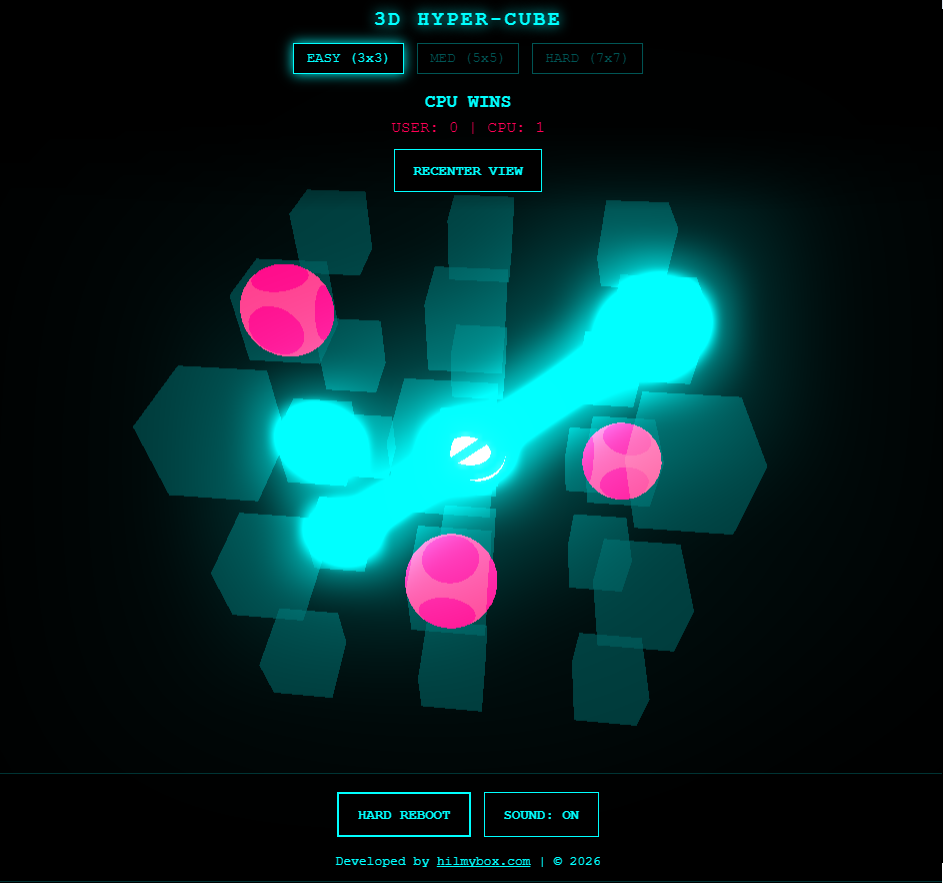
The simplest game you know, lifted into 3D — a small workout for the part of your brain that thinks across three axes at once.
Tic-tac-toe is solved. Any competent eight-year-old can play it to a guaranteed draw. That's why it stops being interesting around age ten.
But the game's design carries an interesting structural seed: the moment you scale it up — bigger grid, more dimensions, more winning lines — the strategy problem opens back up. The 3×3×3 cube version has forty-nine winning lines instead of eight. The 4×4×4 version has even more. The optimal strategy is no longer memorisable; it has to be reasoned about, in three dimensions, every game.
That's enough to make tic-tac-toe a spatial-strategy puzzle worth playing again — and a useful training piece for the same skill Umbra, Lattice, and 3D Sudoku train: thinking across three axes at the same time.
Play it here — runs in any modern browser, with two grid sizes and an AI opponent that fights back.
Who this is for
The audience is anyone whose 2D tic-tac-toe career ended decades ago and is ready for the sequel. Anyone training their spatial reasoning — engineering students, architects, anyone whose work involves thinking in three dimensions. Anyone who likes spatial-strategy puzzles. This is part of the same spatial-reasoning series as Umbra, Lattice, and 3D Sudoku — different mechanic, similar brain-training payoff.
How it works
You see a 3D arena — a 3×3×3 grid of cells floating in a neon-lit space. You play as O. The CPU plays as X. Click any cell to place your mark. The CPU responds with a heuristic search: first checking whether it can win on its next move, then whether it needs to block you from winning, then choosing a strategically placed cell if neither condition applies.
The grid rotates as you orbit it, so you can inspect winning opportunities from any angle. When somebody wins, the winning line lights up as a glowing beam through the cube — useful for confirming, in three dimensions, that the line really was straight.
There's also a 4×4×4 mode for when 3×3×3 starts feeling familiar.
The core idea
The principle is that a game's strategic depth is set by the number of winning configurations, not by the rules themselves. Two-dimensional tic-tac-toe has eight winning lines, which is small enough that the optimal move tree fits comfortably in human memory. Three-dimensional tic-tac-toe has forty-nine winning lines — enough that human players can no longer memorise the entire strategy. The game has to be reasoned through, which means the player has to see in 3D.
That's where the spatial-reasoning workout lives. The player who only thinks in 2D will lose to the player who has trained themselves to scan all three axes at once. Centre control matters more than in 2D, because the centre cell sits at the intersection of more winning lines than any other position. "Double threats" — moves that create two unblockable winning lines at the same time — exist in patterns that aren't intuitive to anyone whose only experience is with the 2D version.
The 4×4×4 version pushes this further. Even more winning lines, no cells with privileged status by themselves, deeper strategic patterns. By that point the game has nothing in common with the 2D original except the rules.
The moment strategy becomes 3D
The reason for building this is a moment that happens about three games in. Early on, you play 3D tic-tac-toe the way you played the 2D version — focusing on rows and columns, occasionally remembering diagonals. Then the AI wins on a pillar, and you suddenly realise you had been ignoring an entire dimension of the board. The next game, you start watching all three axes. The game after that, you start watching the space diagonals too.
That's when the puzzle becomes interesting — and the spatial-awareness training kicks in. The game stops being tic-tac-toe-with-more-cells and starts being a genuinely three-dimensional strategic challenge.
What this is
The simplest game you know, lifted into three dimensions, with forty-one more winning lines and a brain-training payoff. Part of the spatial-reasoning series alongside Umbra, Lattice, and 3D Sudoku. Free, no account, no install.
Coming next
A tutorial article and YouTube video are in production: how this game was built with AI coding agents, including the 49-line win detection and the heuristic AI. Subscribe for when it ships.